Feeds:
Posts
Comments

Archive for the ‘Recipes’ Category

Ricotta Slice

II 011

I love messing with recipes.

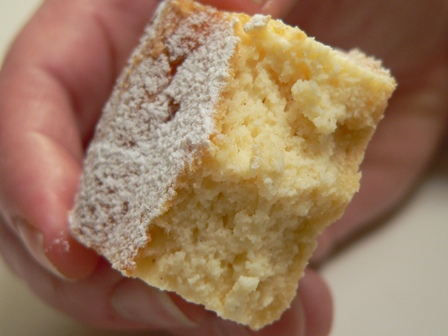
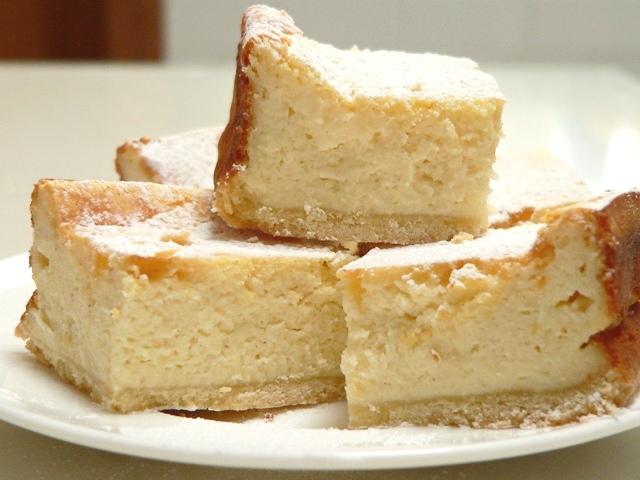
Today I took my ricotta cake recipe and turned it into a slice.  It was the simplest of things to do.  What I’ve discovered is this – the texture of the filling is dependent on how you treat the egg whites.  If you don’t beat the egg whites at all, and simply stir the whole eggs into the mix, your filling will be smooth and cheesecake-like.  In this case, I’ve done both – I’ve mixed one whole egg into the mixture with two yolks, then whipped the remaining two whites up and folded them into the batter.

  • 750g fresh ricotta, drained weight (allow to drain in sieve for an hour before measuring)
  • 375g thick sour cream
  • 3 eggs
  • 225g icing sugar mixture (not pure icing sugar)
  • 45g cornflour
  • 1 teaspoon vanilla extract
  • pinch of cinnamon
  • half a batch of June’s pastry

1. Grease a 27.5 x 23 x 5.5 cm pan with oil spray, then line the base with parchment paper.  I used this pan. Preheat the oven to 150C with fan.

2.  Roll out a rectangle of pastry and line the base of the pan.

3. In a large mixing bowl and with a large fork, mix together the ricotta, sour cream, icing sugar mixture, cornflour, cinnamon and vanilla.  Add one whole egg and two egg yolks, reserving the two remaining egg whites in another bowl.

4. Beat the remaining egg whites until stiff, then carefully fold them into the batter.  Pour the batter into the prepared tin with the pastry base, then bake in the oven for 40 minutes.  The filling will set, and the slice will brown slightly on top.  Turn off the oven and allow the pan to cool, with the door ajar, for at least an hour.

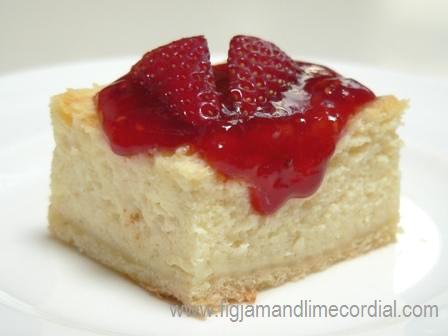
5. Remove the pan and refrigerate until cold, preferably overnight.  Cut into squares, dust with icing sugar and serve. Pete thought it needed dressing up, so we added a little berry coulis and some fresh strawberry!
018a

II 006

Read Full Post »

Photo from Wallace & Gromit – The Official Site

Ahh…Bristol.  Home port to Treasure Island’s Hispaniola, the starting line for numerous Top Gear challenges and of course, the birthplace of Wallace and Gromit.

Joanna, who also hails from Bristol, recently sent me a photo of a  British cottage loaf, an unusually shaped bread made by stacking a small ball of dough on top of a larger one.  As these featured so prominently in the most recent W&G film, I thought it might be fun to try and make some loaves.

Here’s how Jo described them to me:

This is a very old traditional English  bread shape – all bakeries made these when I was a kid. They don’t any more. I think the idea was that you ate the top one first and then the bottom one, so that it would keep fresher through the week.  I don’t know if they were called cottage loaves because they look like a cottage with a roof on, or because they were made at home.  I associate them with thatched cottages and so forth.

I wish one of those old English bakers could come and give me some tips, because these proved (no pun intended) to be quite fiddly!  I couldn’t use my regular bread recipe, as the high hydration made manipulating the dough very difficult.

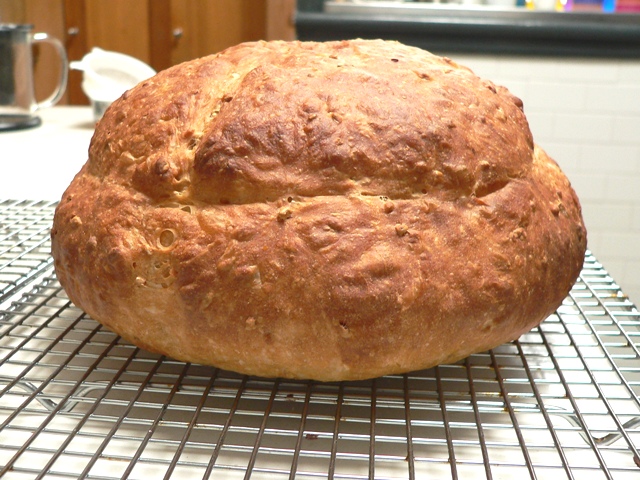
My first attempt ended up as a spaceship, with the two storeys proving into each other.

016

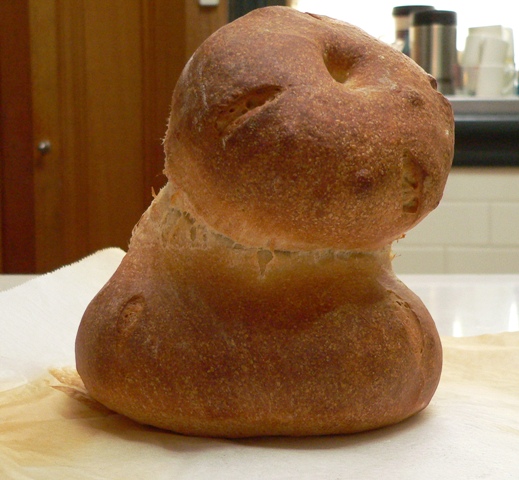
My second attempt mushroomed and Big Boy made rude comments about it.  I made him take it to school for lunch.

CL 021

I tried a third time with a reduced hydration sourdough (60% for anyone interested in the technical details) and a smaller loaf size (600g instead of 900g). I allowed the separate storeys to rest on the bench for 20 minutes, before stacking them and giving them an additional 10 minutes proving time.

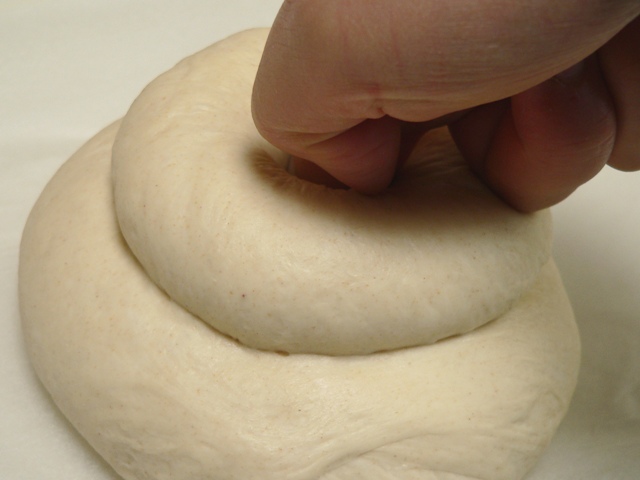
After I’d assembled the cottage, but before the final prove, I stuck my fingers into the middle of the loaf, right down to the bottom, to “weld” the two layers  of dough together.

005

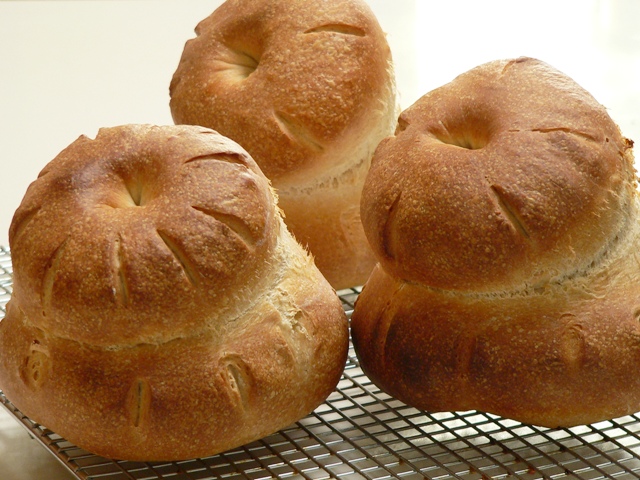
Immediately before baking, I slashed the loaves several times, to  try and control the expansion and reduce the mushrooming effect.  It was moderately successful and I finally ended up with three cottage loaves that I’m pretty happy with.  Meet Larry, Curly and Moe…

023

These loaves have a different texture to the ones I normally bake, with a slightly denser, but at the same time, softer crumb.  The boys are enjoying the change.  Many thanks, Joanna!

. . . . .

Edit: For anyone else who wants to give this a go, here are the quantities I used for the 60% dough:

  • 300g sourdough starter (at 166% hydration, ie. fed on one cup water to one cup flour)
  • 1kg bakers flour
  • 430g water
  • 50g oil
  • 16g fine sea salt

I bulk proved for four hours, then shaped and proved as above.  Each loaf used 600g of dough – 400g for the “bottom floor” and 200g for the “top storey”.

Read Full Post »

Flatbread

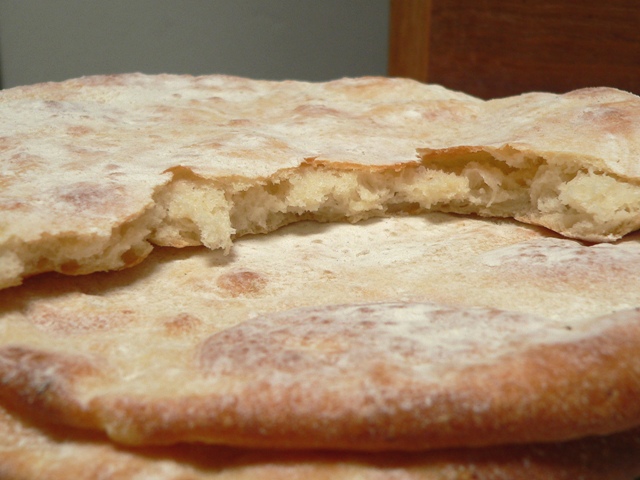
024

Fellow bread baker Joanna put me onto Dan Lepard’s potato stottie cakes. The recipe is from his wonderful book, The Handmade Loaf – which I waxed lyrical about it here.

Jo mentioned that when she’d made this traditional flatbread  from Newcastle upon Tyne, the bread had risen quite a lot, rather than staying flat.  I took a variation of Dan’s recipe and applied my own flatbread methodology, which I’ve used with both yeasted breads and sourdoughs in the past. The end result is always very moreish and, as an added bonus, you can eat the bread hot out of the oven, which makes it a great standby when you’re in a hurry.

Flatbread makes a great accompaniment to Indian and Middle Eastern dishes, though my boys were happy to scoff these smothered in homemade butter.  As I’ve never been to Newcastle upon Tyne, I can’t vouch for the authenticity of the finished product, but they were absolutely delicious!

Here’s how I shaped the stottie cakes…

Turn the risen dough onto an oiled bench and give it a few folds.  Divide the dough into four equal pieces and shape each piece into a tight ball.  Place each ball on a square sheet of parchment paper.  Spray a sheet of clingfilm with a generous coating of oil, then wrap it closely around the dough ball.  Allow the dough to prove for a further 15 – 30 minutes.  Preheat pizza stones in the oven to 250C (with fan).

008

Just before you’re ready to bake, gently flatten out  the dough into a thin pizza-like disc on the sheet of parchment paper, pushing through the clingfilm with your fingers.

010

Carefully remove the clingfilm (if you’ve greased it well, it should come off easily).  Dust the top of the dough with a little flour.

011

Slide the flattened dough, still on its sheet of parchment, onto a pizza stone.  Reduce the heat to 220C with fan. Allow the flatbread to heat up for a few minutes, until the dough starts to rise a little.  Once the dough has started to firm up, carefully remove the sheet of paper and discard.   After a few more minutes, open the oven, pull the rack out carefully, and flip the bread over.  Either use an egg slide, or the “perfect for every occasion when I might give myself a second degree burn” welding gloves.  The gloves really are great for this – I just picked up the flatbread and turned it over!  After a few more minutes, flip the dough over again and bake until the top is brown and the bread is cooked through.

These didn’t take long to cook because they’re so thin – ours were in the oven for about 10 minutes in total.  They were eaten before they had a chance to cool!

012

Read Full Post »

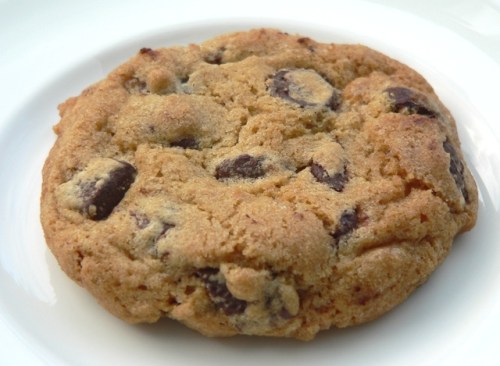
pete's cookie 011

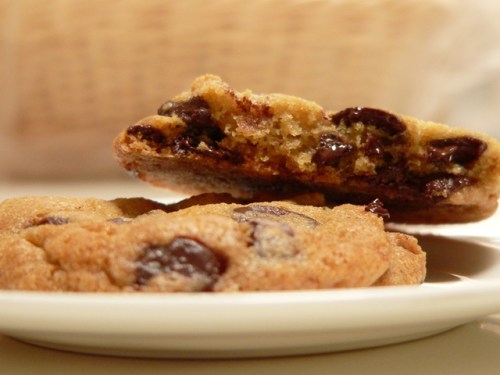
Remember I said we had two chocolate chip cookie recipes that we bake regularly? This one is Pete’s favourite.  It’s basically dark Belgian chocolate held together with a bit of cookie dough.  The boys prefer their cookies with more dough and less chocolate, but Pete really likes the crisp, almost wafer-like crumb and gooey richness of this version.  As this is the grown-ups’ cookie, I’ve included a little 70% dark chocolate in the mix to balance out the sweetness. It’s interesting to note that there’s almost twice as much chocolate to other ingredients in this recipe as there is in the other one.

  • 165g plain flour
  • 35g bread or bakers flour
  • ¼ tsp fine sea salt
  • 120g white sugar
  • 100g brown sugar
  • 125g unsalted butter, cold, cut into small pieces
  • 1 large (59g) egg
  • 1 tsp vanilla extract
  • ½ tsp bicarbonate of soda (baking soda)
  • 150g dark choc chips (Callebaut 54% cocoa callets)
  • 50g very dark choc chips (Callebaut 70% cocoa callets)
  • 100g bake stable dark choc chips (Callebaut 44% cocoa baking sticks, broken into small pieces)

Note : You could use 300g of any dark chocolate – in chip form or broken into chunks.  Just make sure it’s the best you can afford.  The above is what we use in Pete’s cookies.

1. In a large mixing bowl, beat the cold butter and sugars together, until they form a grainy paste.  Beat in the egg and vanilla until just combined (no streaks of butter left).  Do not overmix.

2. In a separate bowl, whisk together the flour, salt and sifted bicarbonate of soda (it’s important to sift the bicarb, or you’ll get bitter lumps in the finished cookie). Add the chocolate to the flour.  Now, tip the whole lot into the batter and mix until just incorporated (no bits of flour left). Do not overmix!

3.  Cover the bowl and pop the cookie dough into the fridge for at least an hour to chill.  These cookies are notorious spreaders, and chilling them helps to minimise this.

4. Preheat oven to 150C (with fan). Line two baking sheets with parchment paper.

5. Scoop balls of dough (I use a small 5cm icecream scoop) and place them on the lined trays, about 10cm apart.

6. Bake for 16-18 minutes until golden brown, rotating the trays once during the baking time.  Remove the trays from the oven, allow the cookies to sit for a few seconds, then transfer them onto a wire rack to cool. Handle with care, as the cookies will be fragile when hot. These will keep well for a few days, stored in an airtight container. If you live alone, freeze some, or you’ll be the size of a bus.

Makes 16 – 20 large cookies.

pete's cookie 003

Read Full Post »

011a

Here’s what was waiting for Big Boy when he came home from school today.

I’d made pain viennois à la Richard Bertinet, using a recipe from his wonderful book Dough.  This after school treat is traditionally served with a stick of chocolate;  in this case a bar of tempered Callebaut 70%.  It was a surprisingly delicious combination.

If you haven’t tried this sweet dough recipe, I hope the photo will encourage you to give it a go.  It’s a very useful addition to your bread baking repertoire.  Our jam doughnuts were made from this dough, as were the hot cross buns we made at Easter.  Because it’s not overly sweet, the dough can also be used for savoury items – Bertinet’s book includes recipes for a bacon slice and croque monsieur, both based around this recipe.

Pain Viennois

  • 500g bread flour
  • 10g instant yeast
  • 7g fine sea salt
  • 40g caster (superfine) sugar
  • 60g unsalted butter
  • 2 large (59g) eggs
  • 250g full cream milk, at blood temperature, or UHT milk, unrefrigerated

Note: UHT milk has a long shelf life and is purchased in cartons from the supermarket shelf.

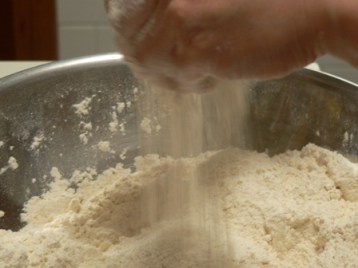
1. Whisk together the dried yeast and bread flour in a large, wide mixing bowl.  Add the salt and sugar and whisk in well.

2. Add the unsalted butter, cut into small cubes, then rub the butter into the flour mixture until well crumbled.

140609 006

3. Add the eggs and milk, then mix together with a spatula until it forms a shaggy dough.  Cover with a tea towel and allow to rest for 10 minutes. Note that this recipe uses two eggs – the photo below was from a double batch.

140609 009

4. Knead the dough until smooth.

5. Oil the scraped-out mixing bowl, then return the dough to the bowl, cover with clingfilm and allow to rise until doubled in size (about an hour).

6. Turn the dough onto a lightly floured surface and gently fold it onto itself. Divide the dough into five pieces, then shape each piece into a long roll.  Place the baguettes on a tray lined with parchment paper, allowing room to spread.  Brush each roll with two coats of beaten egg, before making several deep cuts diagonally across the top with a razor or sharp knife.  Preheat the oven to 200C (with fan).

009

7. Allow the dough to prove for second time until puffed up, then bake in the preheated oven for 10 – 15 minutes, until dark golden brown.  The finished baguette has a brioche-like quality and can be used for a variety of sweet and savoury applications. Make sure you try one stuffed with a good quality chocolate bar!

Read Full Post »

« Newer Posts - Older Posts »