Feeds:
Posts
Comments

Archive for the ‘Recipes’ Category

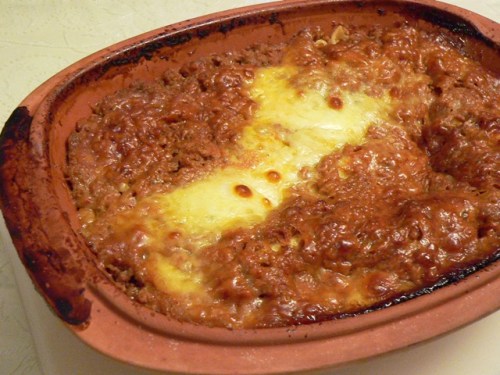
las 052

My husband Pete is a genius.

That’s not news to anyone who actually knows him, but even after twenty-five years together, his cleverness still continues to astound me.  He can take a basic concept, turn it over in his head, and create something that no-one has ever considered before.

Take this lasagne for example.  After his initial resistance, Pete has fallen in love with our Römertopf baker.  He and Dredgey have formed a little club, in which they experiment with new dishes in the clay baker, then ring each other up and race next door to critique the finished dish as it’s pulled out of the oven.  Being males, they’ve come up with a set of guidelines on how the terracotta pot should be used.

Rule #1: all the ingredients  have to be cold and uncooked.  I did point out that some of the recipes that came with the pot involved precooking, but the guys have decided that doing so defeats the purpose of using the clay baker. Both of them were discomfited when I browned some chicken prior to adding it in, as that, apparently, is not “in the spirit” of the Römertopf baker.

Rule #2: the pot needs to be washed in the dishwasher. No soaking allowed.  Part of the reason for using the clay baker, I’m told, is its ease of clean up.  Don’t you love men and their rules?

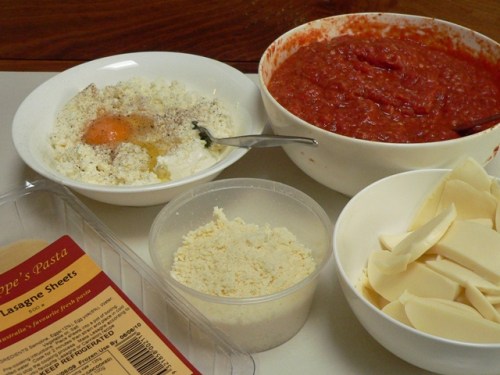
Ok, onto last night’s dinner.  One would think that these parameters don’t really lend themselves to lasagne – a dish where each component is traditionally cooked before assembly, and which usually leaves the cooking vessel covered in baked-on cheese.  Lesser mortals might have been dissuaded, but not my husband.  After all, he’s an engineer. What you see above is his finished lasagne, baked from cold, and made up of almost all uncooked ingredients – fresh pasta, raw mince, ricotta, raw egg and cheese.  The only cooked ingredient was our homemade tomato passata, but this would probably work equally well with a store bought version.

The end result was a joy to eat.  It was absolutely delicious and we didn’t have a white sauce pot, a red sauce pot and a pasta pot to wash up.

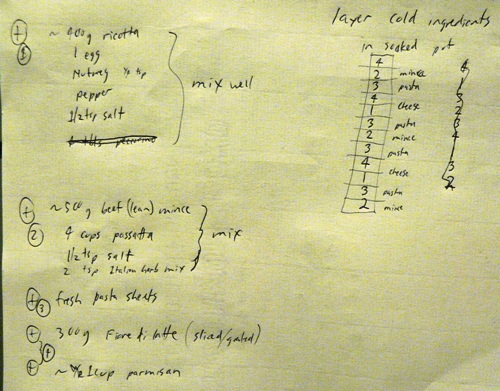
I asked Pete to write up the recipe for me, and this is what I got.  Don’t worry, I’ll translate for you.  Big Boy and I laughed at how typically Pete-like the instructions were, so we thought we’d share it with you. I also thought James might find it amusing – he and Pete both have methodical minds…
004a

White Sauce

  • 400g fresh ricotta
  • 1 egg
  • pinch grated nutmeg
  • pepper
  • ½ tsp salt

Mince Sauce

Fresh Pasta Sheets – about ½ kg (you won’t need them all)

Cheese

  • Mozzarella – 300g – sliced or grated – this is the one we use.
  • Grated Parmesan Cheese – 1 cup

ingredients

Step 1: Soak the Römertopf baker in a sink of cold water for at least 15 – 30 minutes.

Step 2: In a large bowl, mix all the White Sauce ingredients together until well combined.

Step 3: In another large bowl, mix all the Mince Sauce ingredients together, stirring well to break up any lumps in the mince.

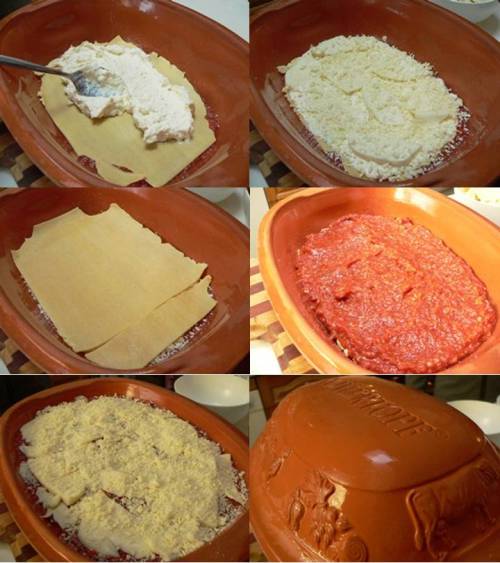
Step 4: In the presoaked pot, spoon a third of the Mince Sauce over the base, then cover with a single layer of pasta sheets.  Follow this with half the White Sauce, then a handful of cheese, then another sheet of pasta.  Repeat, ending with a scattering of cheese on the top. Note that you use a third of the mince sauce each time, and a half of the white sauce.

For the persnickety, here is Pete’s layering chart :

  • Cheese (top layer)
  • Mince
  • Pasta
  • Cheese
  • White Sauce
  • Pasta
  • Mince
  • Pasta
  • Cheese
  • White Sauce
  • Pasta
  • Mince (bottom layer)

montage2

Step 5: Put the soaked lid on the pot, then place in a cold oven and raise the temperature to 200C.  Bake for 1½ hours.  Allow to rest for 15 – 30 minutes before serving, to allow the liquids to absorb into the dish. 

Note: check on the lasagne after the first hour of baking.   If it’s really wet (it will be moist, but shouldn’t be swimming), you might want to let it cook for a bit with the lid off to reduce the excess liquid.  We didn’t need to do this with our dish (ie. we cooked ours for the entire time with the lid on), but it can vary depending on the moisture content of the mince and passata.
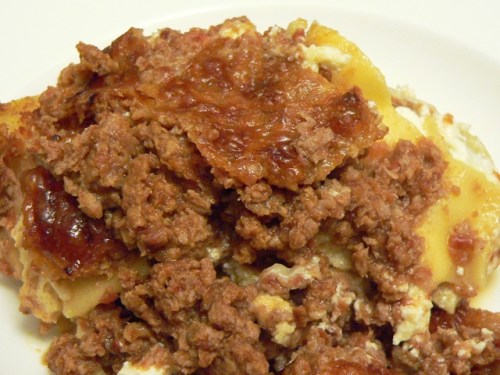
las 009

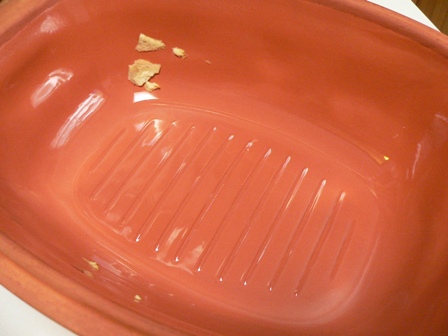
Oh, and in case you’re wondering – see that dirty pot in the top picture, complete with burnt edges where the dish overflowed slightly?  It went in the dishwasher without any presoaking whatsoever.  This is how it came out.  Not completely clean, but oh so close that I really can’t complain…
001

Read Full Post »

almond rocher 003

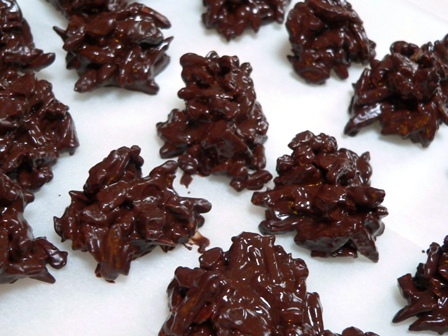
I made these almond rochers with the leftover tempered chocolate from the truffles.  They’re a little too easy, both to make AND eat!

  • 150g almond slivers
  • 1 Tbsp Kirsch
  • 1/3 cup pure icing sugar

1. Preheat the oven to 175C.  In a small bowl, combine the almonds, Kirsch and sifted icing sugar.

2. Line a small baking tray with a sheet of parchment paper, and pour the nuts onto the tray.  Bake the nuts for 10 minutes, or until golden, stirring often (watch them carefully, as they burn easily).

3. Tip the nuts into a small bowl of tempered chocolate, and stir well.  Using two teaspoons, scoop out small blobs onto a sheet of parchment paper and allow to set.  Try not to eat them all at once!

030709 047

Read Full Post »

rcd 018

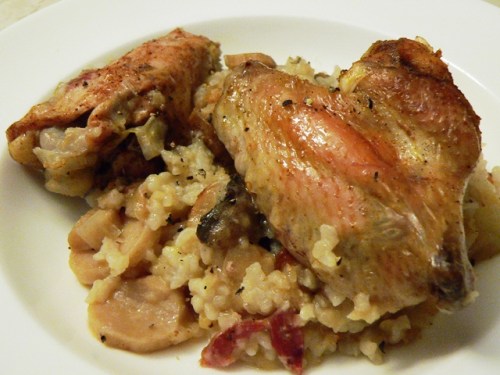
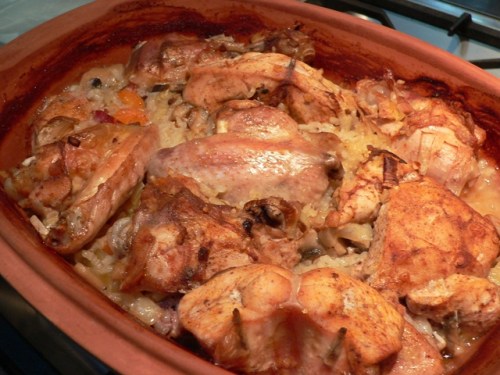
I’m still experimenting with my Römertopf, and tonight’s dish was a hit with the boys.  We’re finding lots of the meals we cook in this terracotta pot are rice based – it seems to really suit the slow cooking process.  This dish was created on the fly tonight and the next time I make it, I’m going to use thighs and drumsticks.  Cutting up the whole chicken into pieces meant that the bone-in pieces cooked to perfection, whereas the breast meat dried out a little too much.

To start with, some basic principles we’ve learnt so far about cooking in the Römertopf:

1. Always soak the pot and lid in cold water in the sink for about half an hour.  Put it in the sink after you’ve washed all your ingredients, and let it soak while you prep.

2. Always put cold ingredients in the wet pot, and pop it into a cold oven, then turn it up to heat.  When you pull it out of the oven, put the hot dish onto some folded tea towels – plonking it on the cold bench might cause it to crack.

3. We always set the oven at 200C fan-forced (electric).  No real reason why, it just seems to have worked for the recipes we’ve cooked so far.  We also seem to cook everything for two hours.

4. Clean the Römertopf by putting it in the dishwasher.  Those are the instructions that come with our glazed pot, and I have to say it’s been cleaning up brilliantly in the machine.

5. Don’t get too stuck on exact quantities or ingredients.  This really is peasant food, so make use of anything you can find in the fridge.  The only rule we have about quantities is this: to make the Arborio rice in the way we like it (sticky and expanded), we need to add twice as much liquid as rice in volume terms.  So for one cup of Arborio rice, we add two cups of water.  In the recipe below, I substituted ½ cup red lentils for some of the rice, which gave the dish an extra sticky consistency.  Surprisingly the lentils disappeared completely on cooking, although they were easy to taste in the flavour and texture of the finished dish.  Feel free to use 1½ cups rice instead if you’d prefer.

Note: when we use Basmati rice, we only add 1½ cups of liquid per 1 cup of rice, as we prefer the texture less creamy in that case.

  • 1 cup arborio rice, rinsed
  • ½ cup red lentils, rinsed and picked over
  • King Brown and Swiss Brown mushrooms
  • 1 carrot, peeled
  • ½ leek (white part)
  • 1 large free-range chicken, or chicken pieces
  • small piece of salami or pancetta
  • 3 cups chicken stock
  • Herbie’s Tagine Spice Mix (I think smoked paprika might a nice alternative, but you could use anything you have at home)
  • salt and pepper

Step 1: Fill the sink with cold water, then soak the Römertopf Baker for 15 – 30 mins.  In the meantime, prepare the ingredients.

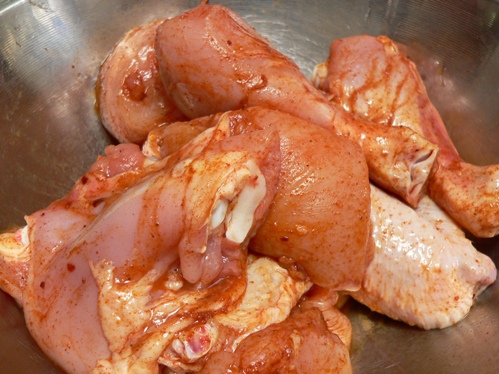
Step 2: Cut the chicken into pieces and remove the skin off everything except the wings.  Rub 1 – 2 tsp of the spice mix onto the chicken pieces.

rcd 003

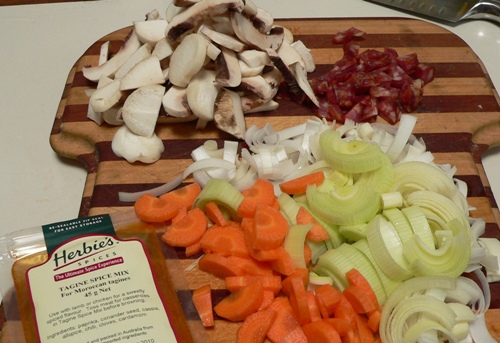
Step 3: Chop up all the other ingredients.

rcd 002

Step 4: Remove the soaked base from the sink.  Add the rice and lentils, then all the chopped vegetables and salami.  Give them a mix to combine.  Nestle the chicken pieces into the rice.  If I was doing this again with a whole chicken, I’d be inclined to bury the breast pieces, to keep them moist.

Step 5: Pour the chicken stock over the ingredients, ensuring all the rice and lentils are covered.  Season to taste with a little salt and pepper (this might not be necessary if you’ve used a lot of salami, or if you’re using a salty chicken stock or spice mix). Take the lid out of the sink and pop it onto the base.  Put the whole pot into a cold oven and turn the thermostat up to 200C.  Note: you might need to do this more gradually if you have a gas oven – please refer to your Römertopf instructions.

Step 6: Come back two hours later and pull the finished dish out of the oven.  Depending on your oven, you might want to check on the dish after the first hour or so to see how it’s traveling.  We usually let our dishes rest a little while before serving, to allow the rice to absorb any excess liquid.  Enjoy!

rcd 007

Read Full Post »

050809 015

I am seriously chuffed with today’s bread.  See the coveted “blistered crust” in the photo above?  It takes a lot of skill and technique to achieve that…or in my case, blind luck.  I’ve never been able to identify what I do that causes the crust to occasionally bubble and blister, but when it does, I feel very pleased with myself nonetheless.

I had to bake four loaves of sourdough this morning, because those sons of mine eat like wolves.  They devour a 650g loaf of sourdough bread every day, plus the occasional loaf with dinner, which means that I need to bake a large batch twice a week. Fortunately, my sourdough starter is now so well trained that it’s a pretty easy process.  It involves very little handling on my part, but lots of time.

Here’s my twice weekly Winter schedule (it changes in Summer because the dough proves much faster):

Day 1, 9am: Take the starter out of the fridge, feed it some flour and water.

Day 1, 2pm: Feed the starter another serve of flour and water.

Day 1, 7pm: Mix up the dough, let it rest briefly. Give it a short knead, then pop it into a large, oiled plastic box to prove.  Actual amount of time spent handling the dough at this stage is about 10 minutes all up.  Go to bed.

Day 2, first thing in the morning: Turn the risen dough onto an oiled bench, divide it up, and shape it into loaves.  Pop them into plastic wicker baskets to prove, covered.  Turn the oven on.

Day 2, an hour later: Turn the loaves onto a peel, slash the tops, then shovel them into the oven.  Bake for 40 minutes.  Remove from oven and cool on wire racks.

That’s it.  Once cold, I slice the loaves up and store them in the freezer, taking one or two (loaves) out each morning, as needed. It’s now so ingrained in our weekly rhythm that I can’t remember the last time we purchased a loaf of bread.

One of the best things about baking your own is that it frees you from the  daily supermarket trek – we only have to go once a month, if that.  Plus it saves us a fortune – a good loaf of sourdough can cost between $5 and $8, whereas our loaves work out at about 65c each.  And that’s using premium extra virgin olive oil and top quality bakers flour. When you multiply that by at least eight loaves a week, it’s a pretty substantial saving!


050809 017

Read Full Post »

090709 008a

David Lebovitz has done for chocolate what Bruce Lee did for kung fu  – he has demystified a formerly secretive art and made it accessible to the general public.  Ok, so I never managed to learn kung fu (take that sad image out of your minds right now), but I have learnt to do clever things with chocolate. And like the Dragon, in Lebovitz’ case, it’s all about technique.  His recipes aren’t overly complicated, but their success or failure depends entirely on execution.

A wonderful case in point is the recipe for hot chocolate in his new book The Sweet Life in Paris (which is a great read, despite its mildly-annoying-but-very-French deckle cut finish).  It’s a simple recipe; just milk, chocolate and a pinch of salt.  However, made correctly, it is creamy, smooth and delicious – we’ve grown quite addicted to it as a restorative tonic and now keep a small bottle in the fridge at all times for emergencies.

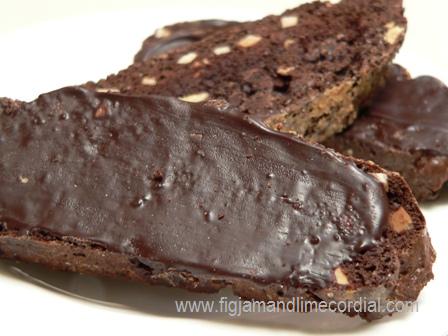
Last night, I whipped up a batch of Lebovitz’ dark chocolate biscotti. The original recipe is on his blog and I was planning to reproduce it here, until  I realised that I really couldn’t explain the methodology any better than he has.  For what it’s worth, I used Callebaut dutch cocoa in mine, which resulted in an extra dark cookie.   They’re very grown up, yet oddly reminiscent of the politically incorrect Golliwog biscuits of my childhood – while completely different in shape and form, the flavour jogs something in the recesses of my brain (I think it’s the crispness combined with the cocoa).  Some of the biscotti were treated to a coating of tempered chocolate, which made them ridiculously moreish, particularly with a hot cup of tea.

200709 002a

I now own two of Lebovitz’ books  – The Sweet Life in Paris and The Great Book of Chocolate.  They’re informative, entertaining and occasionally hysterically funny.  He also writes a great blog, where it’s easy to while away a couple of hours, particularly if you’re a seasoned virtual traveller like moi.  Just be careful, though, or you’ll end up with an expensive chocolate addiction like the rest of us…

Read Full Post »

« Newer Posts - Older Posts »