Feeds:
Posts
Comments

Archive for the ‘Recipes’ Category

High Hydration Sourdough

Warning: an über-geeky bread post follows!

. . . . .

The other day, I caught Pete spraying one of my hot ciabatta loaves with water. When I asked him what he was doing, he replied “the crust hurts the roof of my mouth, so I’m spraying it to soften it before I eat it”.

Clearly, it was time to change my approach. As with all things in life, my bread making is constantly evolving to meet the needs and tastes of our family. For the past few years, we’ve mostly eaten heavily crusted, chewy loaves, but these can be hard on the teeth and palate – it was time to add alternatives to our repertoire.

The first thing I tried to do was to increase the water content in my sourdoughs. This is known as the hydration of the dough, and it refers (as a percentage) to the amount of water used compared to the quantity of flour. For example, if there is a kilo of flour and 700g of water in a recipe, then the hydration of the dough is 70%.

My standard formulas are between 65% (rolls and baguettes) and 77% (ciabatta). As I usually use a mix of bakers/bread flour and remilled semolina flour (semola rimacinata), these numbers tend to be a little higher than doughs made with just bakers flour, as the semolina flour absorbs more water.

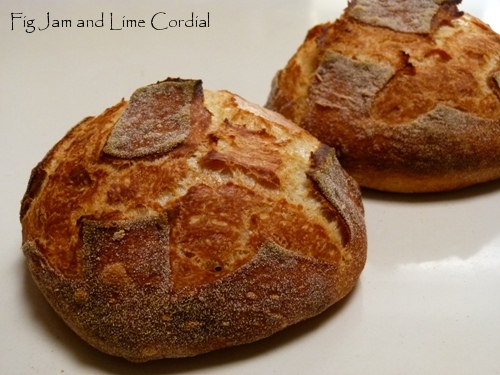
My first attempt at an 82% loaf produced a great result, but still with a thick, hard crust…
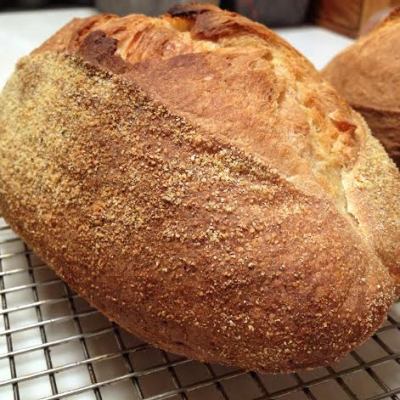
I felt that the dough could take even more water, so I upped the hydration to 90%. I also tried baking the bread in a covered pot – which involved preheating one of my Emile Henrys to blazing hot, then dropping the risen dough into it. This worked brilliantly – the steam released from the high hydration dough was captured in the pot, and kept the crust from hardening up before it had risen to its full potential. The finished crust was crispy yet thin, and the crumb was tender and elastic.

However, it  was all a bit intimidating – manoeuvring the flaming hot, heavy pot out of the oven, then trying to get the dough in without burning myself on the high sides of the base. In addition, I was a bit concerned about heating my empty clay pots to such high temperatures on a regular basis.

After bouncing ideas off my friends Joanna and Carl on Twitter, I invested in a couple of enamel roasters from Falcon. These oval pots are lightweight, oven safe to 270C, and fairly reasonably priced – the 30cm one below was just $32 at Peters of Kensington. They also have low sides and a high domed lid, and fit the doughs shaped in my oval bannetons perfectly.

The first 90% loaf I baked in it was a glorious success…
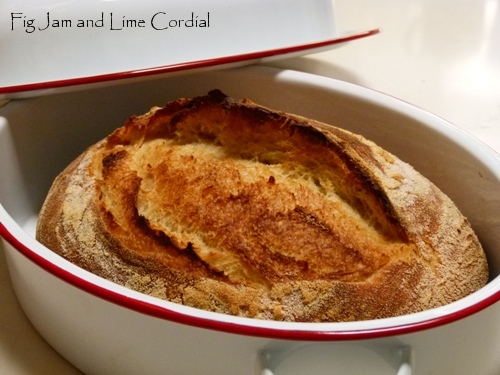
The pot was preheated to the maximum oven temperature, then the dough was plonked in, slashed, covered and put back in the oven. I reduced the temperature to 220C with fan and baked it for 20 minutes covered, 20 minutes uncovered, then a further 10 minutes at 175C with fan…
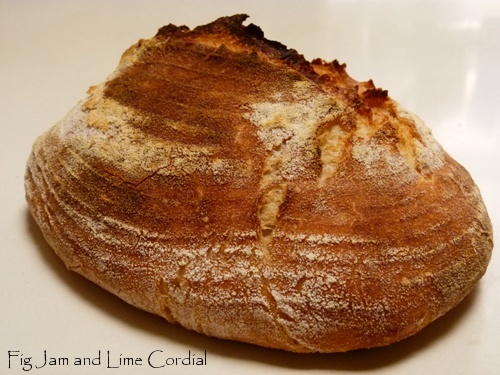
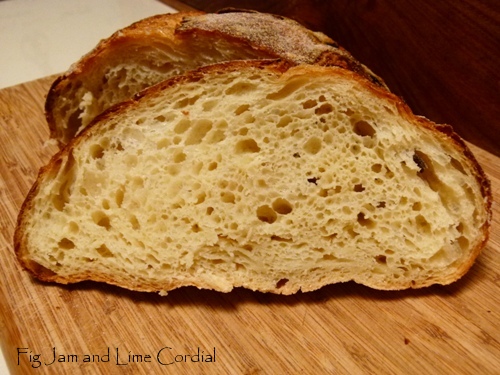
See how thin the crust is? The crumb was surprisingly closed for such a wet dough, which of course made me think that I could add even more water…
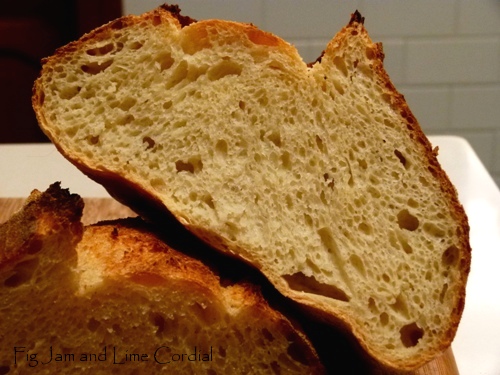
I also attempted some 90% hydration ciabatta loaves – the wet dough handling and shaping took a bit of getting used to, but ample dusting with fine semolina made it all much easier…
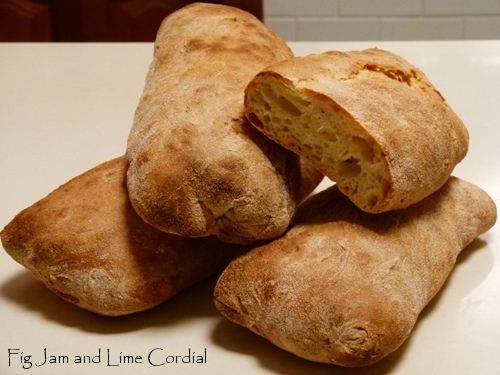
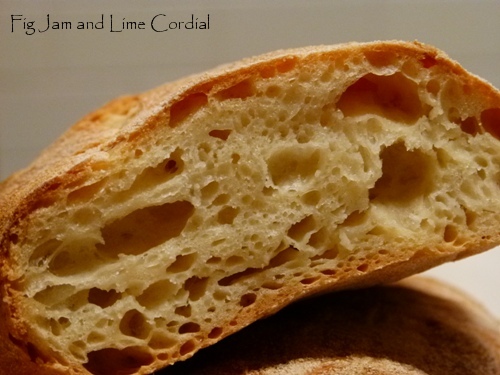
The extra water gave the ciabattas a thinner crust and a very moist, slightly rubbery crumb (which is a good thing, despite how it sounds)…
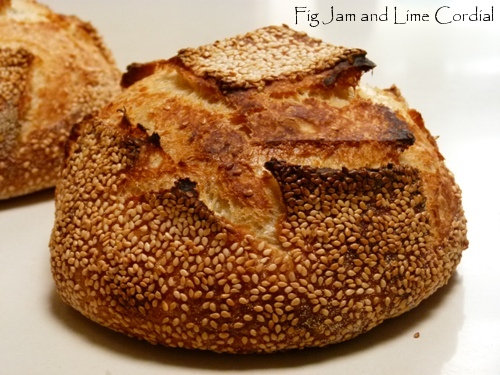
I’d bought both the small and large roasters, and found the larger one perfect for baking two small round loaves in – those below were dipped in sesame seeds prior to baking.

A note on the pots – I can just fit a large and a small one side by side in my 90cm freestanding oven, but most ovens could only take one at a time. The 36cm is huge, and if you’re only baking one loaf at a time, the 30cm one is a great size.
So…could I make a 100% hydration loaf? My friend Kevin the miller insisted it was possible, and now that I knew the pot baking worked, I figured it was worth a try. I was a bit worried though when the dough I mixed at 6am looked like a thick soup…
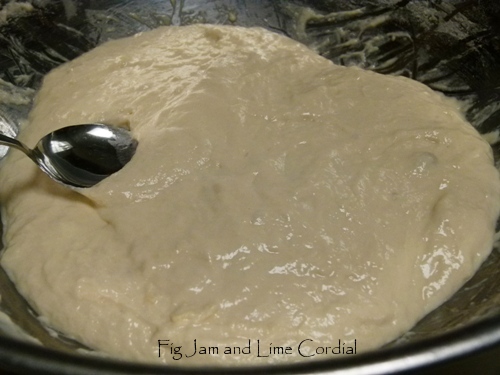
Over the course of the day, I gave the dough a couple of folds whenever I walked through the kitchen, and was astonished to watch it develop tension and body. At 3pm, I turned it onto the bench, folded it onto itself a few times, and let it rest.

After half an hour’s bench rest, I dusted and gently shaped it into a large flat rectangle – that was all the shaping the dough would allow. It proved in this form for a further 40 minutes…
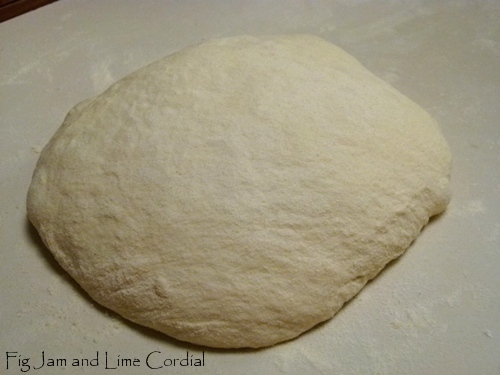
I slashed optimistically and then scooped the dough into my large preheated roaster…
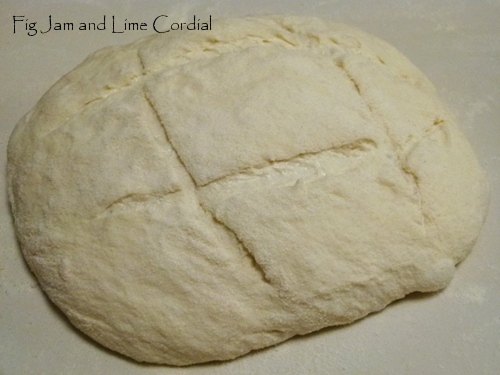
And this was how it came out of the oven! I was so pleased…
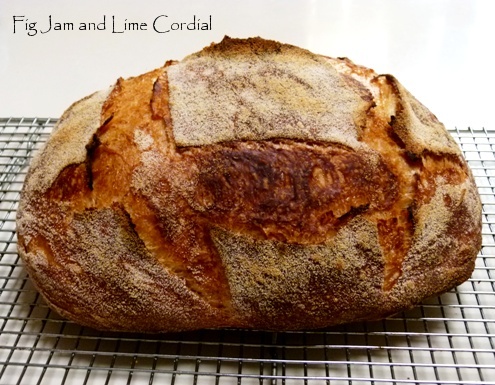
The crust was crispy and thin, with a tender yet elastic crumb…

The extra water content increased the keeping time of the loaf – it was still fresh and tender two days later…
Here’s the basic formula:

  • 300g active sourdough starter (fed at a ratio of 1 cup water to 1 cup flour)
  • 500g bakers/bread flour
  • 500g remilled semolina flour (semola rimacinata di grano duro)
  • 20g fine sea salt
  • water: 820g (90% hydration loaf) or 930g (100% hydration loaf)

Place the covered pot in the oven as it preheats to 240C with fan, then carefully take it out of the oven and remove the lid. Gently (don’t burn yourself!) put the shaped and slashed dough into the base and replace the lid, then return the pot to the oven, dropping the temperature to 220C with fan immediately. Bake for 20 minutes with the lid on, 20 minutes with the lid off, and then an additional 10 minutes at 175C with fan (if needed).

. . . . .

Are you still with me? I did warn you that this was a very geeky bread post!

I’ll still be baking loaves the “old” way as well, but it’s nice to add something different to our bread line-up. I’ve wanted to do more pot baking in the past, but have always found taking heavy, blazing pots from the oven a bit intimidating. The enamel roasters really do overcome that issue.

Do you bake your bread in a pot? My friend Emilie does, and she puts hers into the oven cold! Have a look at her amazing loaves here.

. . . . .

More geeky bread experiments here!

Read Full Post »

Poppy Seed Crackers

Small Man adores crackers.

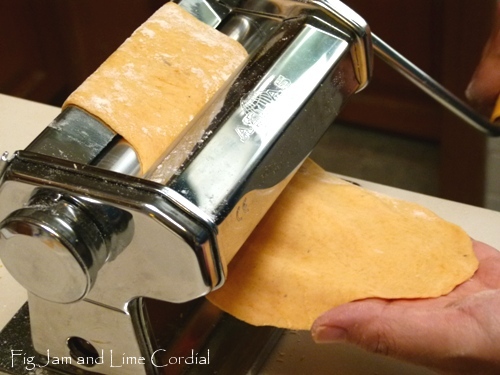
I couldn’t make enough of them for him – I’d fill the cookie jar in the morning, and he’d empty it before dinner that evening. I needed to find an easier way to churn them out, and after a discussion with Greg from Rufus’ Food and Spirits Guide, I thought I’d try using the pasta machine.

I originally experimented with a double batch of olive oil and paprika dough (based on an Ottolenghi recipe, which I originally blogged about here):

  • 500g plain (all purpose) flour, plus extra for dusting
  • 10g (2 teaspoons) baking powder
  • 230ml water
  • 50ml olive oil, plus extra for brushing
  • 6g (1 teaspoon) fine sea salt
  • 2 teaspoons sweet paprika
  • several generous grinds of black pepper
  • Maldon flaky salt for sprinkling

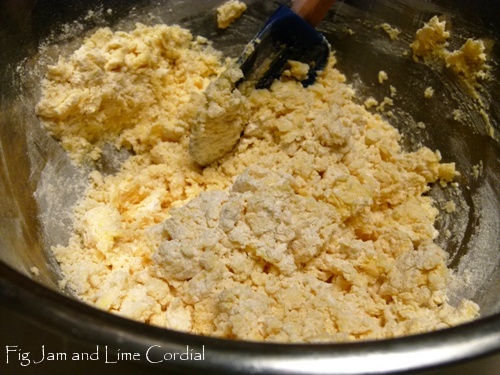
1. In a large bowl, mix together all the ingredients except the Maldon salt.  Squelch the mix between your fingers to get it all combined, then turn the dough out onto a clean workbench and knead it briefly until smooth.  Wrap in cling film and leave it to rest for an hour in the fridge.

2. Preheat the oven to 210°C (or 200°C with fan).  Dust the bench well and turn out the dough, dividing it into 20 roughly equal sized pieces. Roll each into a ball, and cover with a tea towel, working with just one at a time.

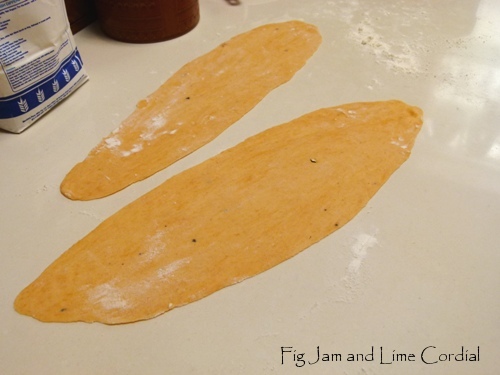
3. Flatten a ball of dough, dust well with flour, and pass it through the pasta roller – I started on the widest setting and worked down to six on my machine. Each small ball of dough ends up as a long thin oval. Dust with flour as needed.

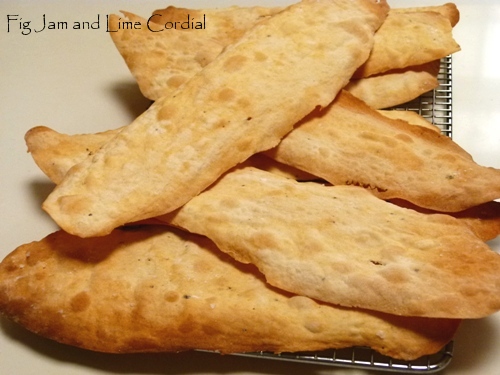
4. Place the crackers on a parchment lined baking tray, brush the tops with a little olive oil, then sprinkle on the Maldon salt flakes.  Bake for 6 – 8 minutes, rotating once during the baking time, until crisp and golden brown.  Store in an airtight container.

Our second attempt – a poppy seed version – proved to be even more popular with Small Man than the original…

  • 500g plain (all purpose) flour, plus extra for dusting
  • 10g (2 teaspoons) baking powder
  • 230ml water
  • 50ml  olive oil, plus extra for brushing
  • 6g (1 teaspoon) fine sea salt
  • 16g (4 teaspoons) poppy seeds
  • several generous grinds of black pepper
  • Maldon flaky salt for sprinkling

A few notes:

  • The rolled out “leaves” (as Small Man calls them) are quite long – if you have a standard 60cm oven, you’ll probably only be able to fit two or three per tray. Even with my free standing 90cm Smeg oven, it takes me at least two bakes to get these all done.
  • The dough quantity can easily be halved, but I find the large batch gives us plenty to share. Also, it seems a great shame to heat up the oven for just one short bake!
  • Be a little careful with the poppy seed crackers – if they get too dark, the seeds can end up bitter. I found eight minutes was the perfect time in my oven, but nine minutes was too long – your oven will probably be different, so you might need to experiment a little.

This cracker dough is a joy to work with – it’s not overly sticky, so it doesn’t make a mess of the pasta machine or the bench, and because it isn’t yeasted, it doesn’t need to prove prior to rolling out and baking. I have found that resting it in the fridge improves the flavour of the finished crackers, but it’s not essential if you’re in a rush.

Small Man has already made short work of the ones in the cookie jar – just as well I hid some in a sealed bag in the pantry for tomorrow!

Read Full Post »

Soothing Shortbread

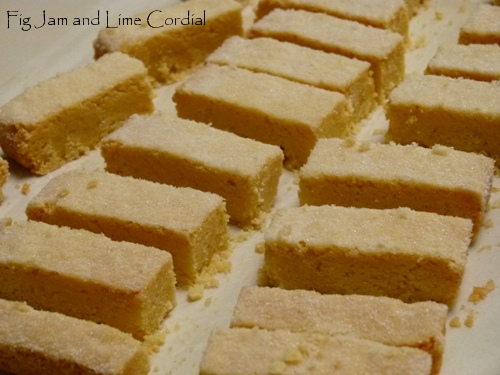
This lovely shortbread recipe, from the first Tartine cookbook, is gentle and peaceful to make and delicious to eat.

It’s made entirely by hand without the use of a mixer or food processor (although I do soften the butter in the microwave), which makes it an ideal “early morning while everyone is asleep” bake.

The unsalted butter needs to be really soft (but not melted) before beginning – I do this by heating the cold chunks of butter in the microwave on a very low power setting (3 out of 10) in 20-30 second bursts. Squish and stir the butter with a fork as it softens. It starts out like this…

…and after a minute or so, looks like this…

I’ve rounded off the metric weights to make it easier and baked the dough in a 31 x 14cm/12 x 5½” biscotti pan, lined with parchment paper. A 20cm/8″ square pan should also work, and the original recipe suggests a 6″ x 10″ glass baking pan.

Be light-handed and resist the urge to beat the dough, which I suspect would toughen the texture of the finished shortbread.

  • 250g unsalted butter, softened
  • ¼ – ½ teaspoon fine sea salt*
  • 250g plain (AP) flour
  • 75g cornflour (cornstarch)
  • 70g white sugar
  • caster sugar (superfine sugar) – for topping

Note: Pete prefers the shortbread with more salt (the original recipe specifies ½ teaspoon), whereas Big Boy prefers it with less. Sigh.

1. Preheat oven to 160C with fan. Scrape the softened butter into a large mixing bowl and stir in the salt. In a separate bowl, sift together the plain flour and cornflour (don’t skip this step).

2. Stir the white sugar into the butter and mix only until combined. Then add the flours and mix again until just combined – treat the mixture gently and don’t overwork it…

3. Scrape the dough into the prepared tray and spread it out evenly (you might need to use your hands). Bake for 30 – 35 minutes until lightly browned. Photo below shows the pan ready to go into the oven…

4. Let the shortbread cool briefly on a wire rack and, while it’s still warm, generously sprinkle over a couple of large spoonfuls of caster sugar. Shake the baking tray gently to spread the sugar coating, then carefully tip off the excess. Also, while the shortbread is still warm, cut it into slices, then leave it in the pan to cool completely before serving.

I find the texture and flavour improves with a day’s rest…

This recipe produces a very tender shortbread compared to the crunchier rice flour versions. It’s also quite rich – one small finger with a cup of tea is very satisfying!

Read Full Post »

Seed-Topped Bagels

We adore sourdough bagels, but the yeasted ones are quick and easy – I can start in the morning and have a batch ready by lunchtime.

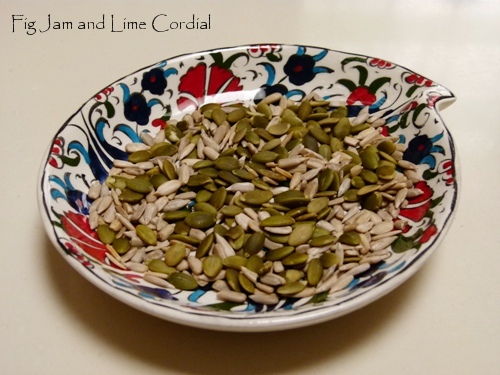
As we’d run out of sesame seeds, I raided Pete’s muesli supplies for other toppings. I made a double batch of our bagel dough following these instructions and using these quantities:

  • 1.2kg bakers/bread flour
  • 21g fine sea salt
  • 20g dried yeast
  • 750ml water
  • 50g malt extract

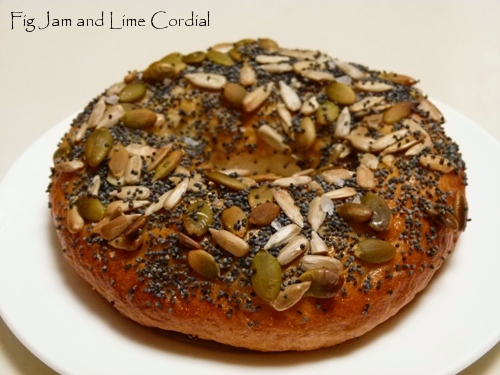
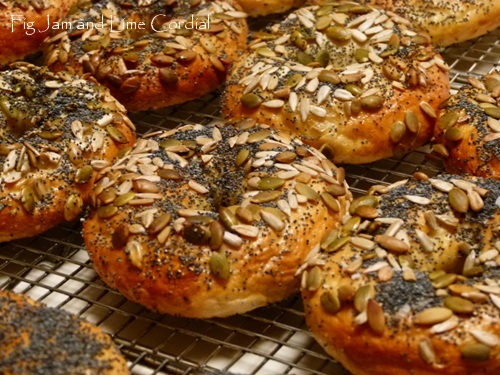
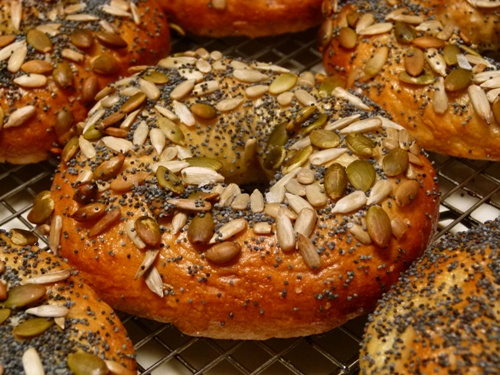
After boiling the bagels, I brushed them with egg wash and carefully dipped them into a plate of pumpkin and sunflower seeds (be careful not to deflate the bagel)…

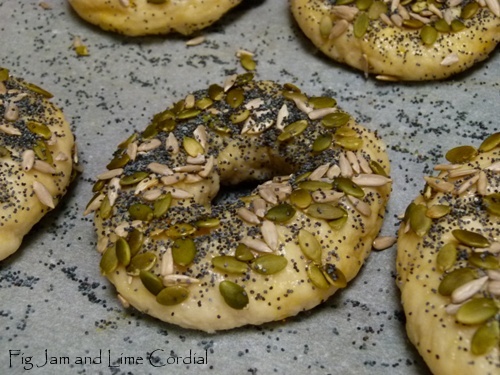
The bagels were placed on a parchment lined tray, then poppy seeds and a little crushed flake salt were sprinkled over the top…

They baked to golden in just 20 minutes in a 200C fan-forced oven…

These were so delicious that we ate them without any filling. The seed topping is quite fragile though – handle with care, or you’ll end up with a denuded bagel. We’ll definitely be making them again!

Read Full Post »

A Bag of Flour

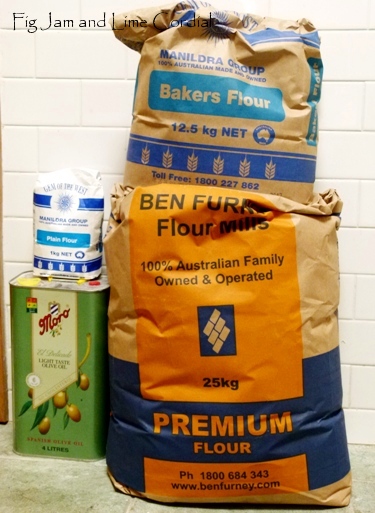
It’s hard for me to convey in words how happy and contented a large bag of bakers (bread) flour makes me. To me, it’s like having money in the kitchen bank – no matter what happens, I know that, at a bare minimum, we’ll have bread to eat.

One of the greatest influences on my adult cooking life was this description of Laura Ingalls Wilder’s first kitchen in These Happy Golden Years

Beneath this shelf were many drawers of different sizes. Directly below the spices, and above the window shelf, were two rather narrow drawers. Laura found that one was almost full of white sugar, the other full of brown sugar. How handy!

Next, a deep drawer was full of flour, and smaller ones held graham flour and corn meal. You could stand at the window shelf and mix up anything, without stirring a step. Outside the window was the great, blue sky, and the leafy little trees.

Oh, how desperately I wanted this when I was twelve years old! My mother was (and still is) a wonderful cook, but she never baked. As I’ve mentioned before, she used to store her excess crockery in the oven. The Little House books made life sound very hard, yet so honest and self-reliant, that I wanted it all – I wanted to build whatnot shelves, and twist hay into sticks for the fire, and make maple candy.

More than thirty years on, I feel like we’ve achieved this to some small extent. I can, indeed, stand at my kitchen bench and mix up anything, without stirring too many steps. And this huge sack of flour, which cost just $25, will keep my family, friends and neighbours in bread for a couple of months. To give you some idea of how far the bag will stretch, 25kg of flour is enough to bake…

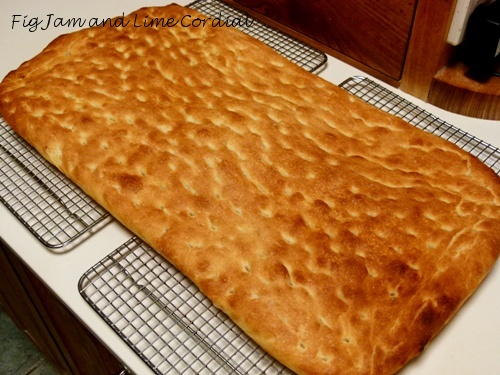
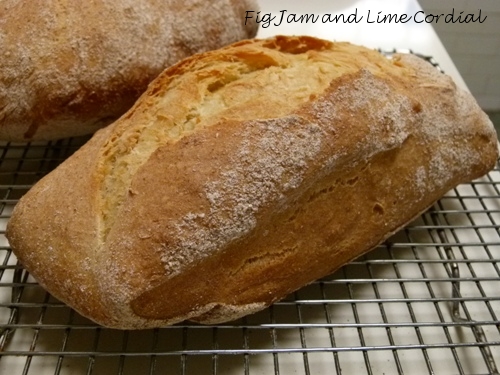
…twenty giant 90cm slabs of sourdough focaccia

…or a hundred yeasted pane de casa loaves..

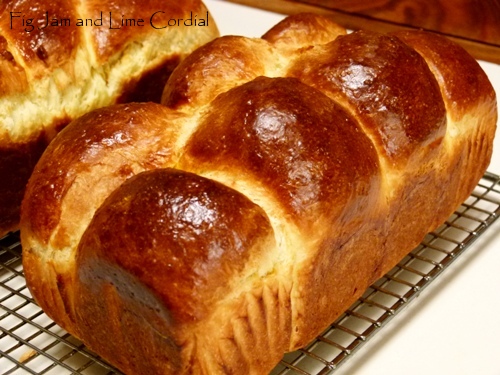
…or seventy-five loaves of faux brioche

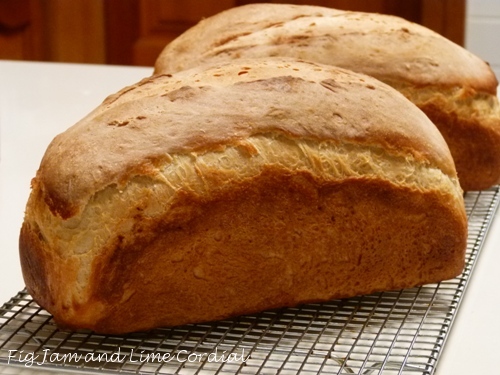
…or thirty-five large white sandwich loaves, either yeasted or sourdough

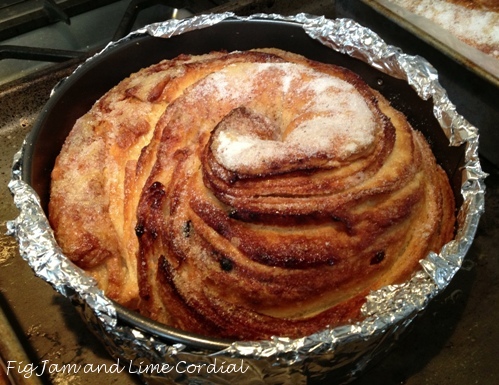
…or fifty rich and luscious lardy cakes

What food dreams did you have when you were a child?

My father, who grew up during the war, told me that when he was young, all he wanted from life was to sit at the movies and eat an endless supply of chocolates from a box.

Pete’s family had goats when he was a child, and as a result he won’t go near their meat or byproducts (not out of sentimentality, but because he can’t stand the taste or smell). I on the other hand longed to be like Heidi in the Alps, drinking fresh goats’ milk and eating bread covered in melted cheese.

What were the childhood influences that shaped your cooking and eating?

Read Full Post »

« Newer Posts - Older Posts »