Feeds:
Posts
Comments

My friend Karen hates clutter.

Whenever our kids had a school project, she would go out and buy all the necessary craft supplies. Once the task was completed, any excess materials were discarded immediately, rather than stored for future use.  And when the next diorama project came up (you have no idea how grateful I am that we don’t have to do those anymore), Karen would get back into the car and go shopping.

I am the complete opposite of this. I like to have things on hand, ready for any contingency (or diorama) that might arise.  This is especially true in the kitchen, where I’ll often pick up ingredients with no specific recipe in mind.

Such was the case with the French hazelnut praline I bought a couple of months ago…
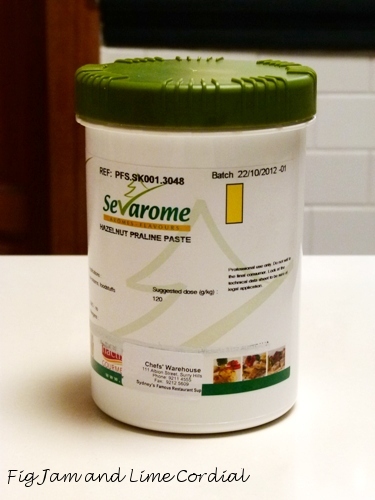
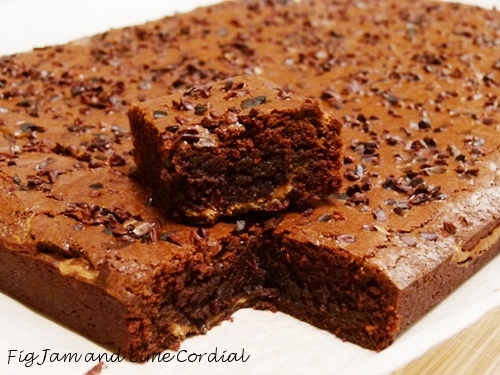
I also had a bag of cacao nibs in the pantry and thought it might be nice to combine the two in a brownie.  I started with a Nick Malgieri recipe, and tweaked it to incorporate the praline by reducing the sugar and altering the methodology slightly…
  • 225g (8oz) unsalted butter, cut into chunks
  • 250g (9oz) dark (bittersweet) chocolate – I used Callebaut 70% cacao callets
  • 210g (1 cup) dark brown sugar
  • 165g (¾ cup) white sugar
  • 4 medium (55g) free range eggs
  • ¼ teaspoon fine sea salt
  • 3 teaspoons vanilla extract (I used homemade)
  • 190g (1¼ cups) plain (AP) flour, sifted
  • 60g (½ cup) cacao nibs
  • 110g (¼ cup) hazelnut praline paste

1. Heat oven to 175C (350F) or 160C (320F) with fan.  Line a 23cm x 33cm (9″ x 13″) baking pan with parchment paper.

2. In a large pyrex bowl, melt the butter and chocolate together in the microwave, using short bursts on high, stirring frequently. Be careful not to scorch the chocolate.

3. Beat the brown sugar in the large bowl of an electric mixer to break up any lumps.  Add one egg, and beat on low to combine, then add the remaining eggs one at a time, beating well after each addition. Beat in the white sugar, salt and vanilla extract.

4.  Stir in the melted butter and chocolate, then gently fold in the flour and ¼ cup of the cacao nibs (reserve the rest for later).

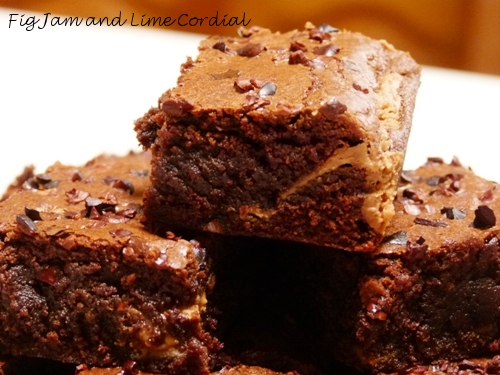
5. Scrape half the batter into the prepared pan.  With a teaspoon, drizzle the hazelnut praline over the surface of the batter, making pretty patterns as you go.  Carefully pour the remaining batter over the top.  Evenly sprinkle over the remaining cacao nibs.

6. Bake for 30 minutes until firm, then place the pan on a wire rack and allow the brownies to cool completely. Nick’s original recipe says to refrigerate the brownies for several hours before cutting, but mine were firmer and didn’t need that (I suspect it’s because I used smaller eggs – also, my metric conversion for a cup of flour is heavier than his).

Note: the original recipe doesn’t include hazelnut praline. It uses an extra ¼ cup of brown sugar, an extra ¼ teaspoon salt, and large eggs.

These were delicious – the praline flavour is subtle but noticeable, and the nibs add both a satisfying crunch and a hint of bitterness.  It’s a lovely big bake too – the slab cut into thirty-six pieces, so there was ample to share around!
As you might recall from a few weeks ago, I’ve been sharing my sourdough starter Priscilla with friends.  Here are the latest additions to her family tree:

. . . . .

Offspring: Shebru (Peter and Anne in Wellington, NZ)

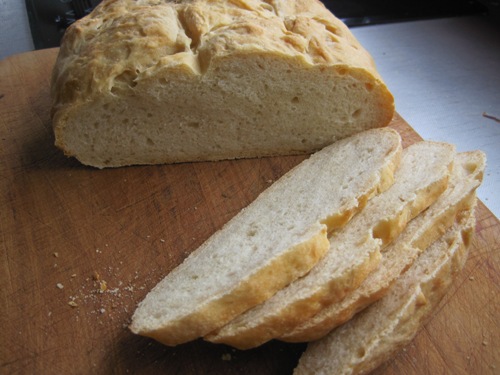
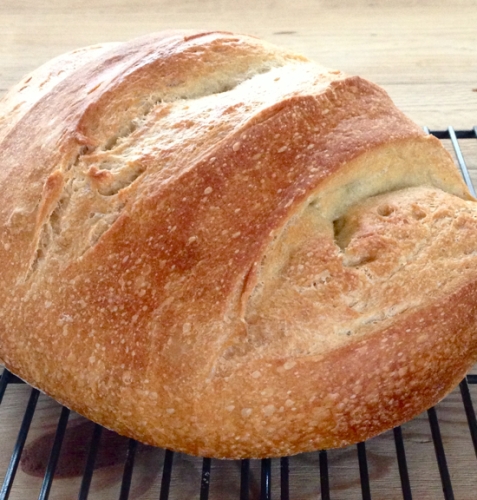
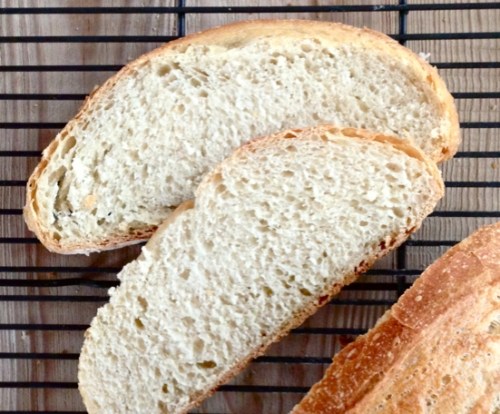
Our old friend Anne has hit the ground running with her androgynous starter (“Shebru” being a contraction of “Sheila” and “Bruce”).  And despite never having baked bread before, Anne managed to produce not only a beautiful loaf on her first attempt, but also a half batch of sourdough bagels…

. . . . .

Daughter: Kate (Jo in Queensland)

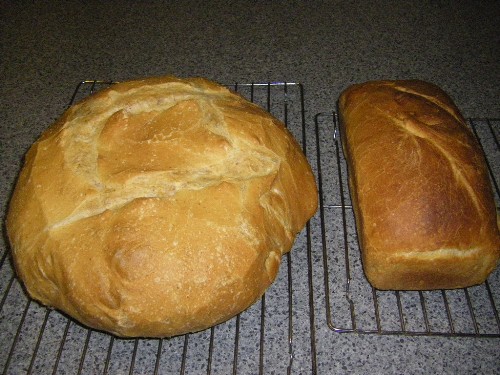
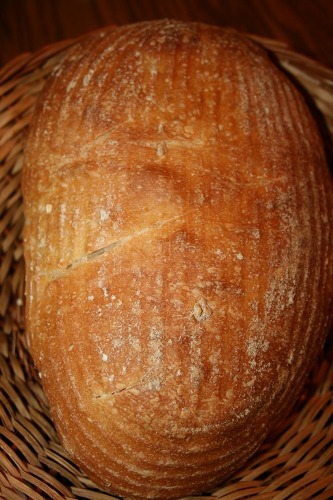
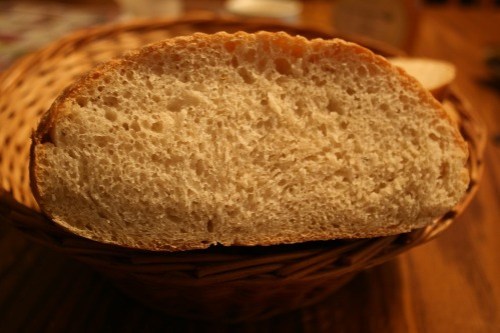
Lovely fellow gardener Jo was keen to compare Priscilla’s daughter Kate against her old starter, and baked two loaves – Kate’s is the round freeform one on the left with the highly coveted blistered crust…

The feedback I’m getting is that Priscilla is far less sour than most wild yeast starters…

. . . . .

Daughter: Maggie (Clare in Victoria @ The Life of Clare)

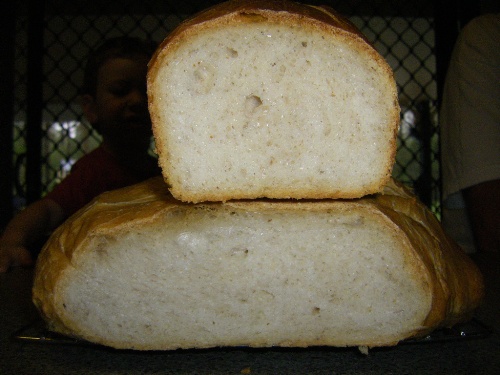
We were delighted when Clare named her starter Maggie (we lost our chook Maggie recently), and even more delighted when her very first loaf turned out so sharp! Clare’s off and running now, and recently baked her first fruit loaves. You can read all about it here

. . . . .

Daughter: Cordelia (Tandy in South Africa @ Lavender and Lime)

My friend Tandy lives over 11,000km away in South Africa and as I’d never mailed anything there before, I wasn’t sure that my envelope of dodgy looking white flakes would actually make it through the postal system!

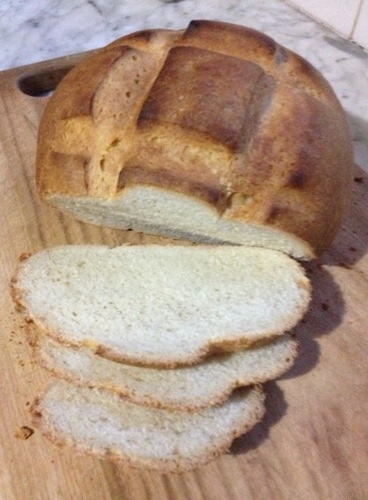
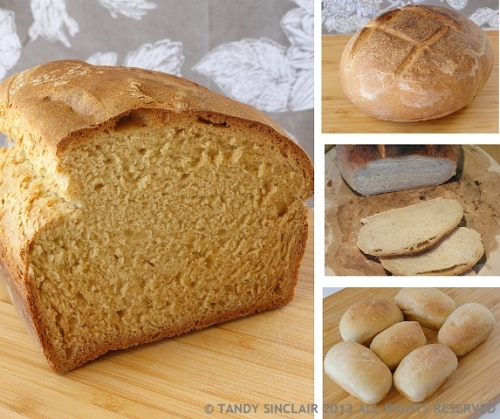
Thankfully it did, and Tandy has truly embraced the sourdough adventure – her first loaf (top right) had so much oven spring that it touched the top elements, and since then she’s baked an English muffin loaf and rolls.  I’ve been excitedly following her baking adventures on twitter…

. . . . .

Son: Thing Two (Heidi in Ohio, USA @ Steps on the Journey)

I was so happy to send a little bit of our starter to darling Heidi, as I knew the Bread Queen would do wonderful things with it!  She too pointed out that Priscilla is far less sour than her existing starter, but that’s not necessarily a bad thing, as her husband Frank really liked Thing Two’s loaves. Have a look at all the amazing things she’s been baking (and also read her views on bread making) here

. . . . .

Son: Dillon (Emilie in New York, USA @ The Clever Carrot)

Lovely Emilie is a kindred spirit and a fabulous baker! Her starter Dillon (named by her son) has been turning out beautiful loaves in her kitchen. I can’t wait to see what she does next with him…

“The craft is your rocking chair, you lean back
on it so you can rest, and then have the artistry..” 

Frank Oz

. . . . .

When I wrote my Bread #101 yeasted and sourdough tutorials, I wanted to come up with a really simple way to create a delicious loaf of bread. The posts were only ever intended to offer a starting point, because I knew that once someone had convinced themselves that it was actually possible to bake a successful loaf, then they were off and running.

And that’s certainly proven to be the case! In the space of just a few short weeks, Michelle has moved from yeasted to sourdough, Rachel has baked both grain and olive breads, Alison has perfected her chewy ciabatta, and Clare has created gorgeous fruit loaves. My darling friend Wendy, whom I passed starter to several years ago, is now busily teaching all her friends how to bake sourdough bread.

With just a little practice, a novice baker will soon develop the confidence to experiment and play, developing their own unique style in the process. Experience enables us to know intuitively whether or not a dough is too dry, sufficiently proved or baked long enough in the oven. And as the Frank Oz quote above says, once we’ve  attained a little mastery of the craft, we can lean back on those skills, and be creative.

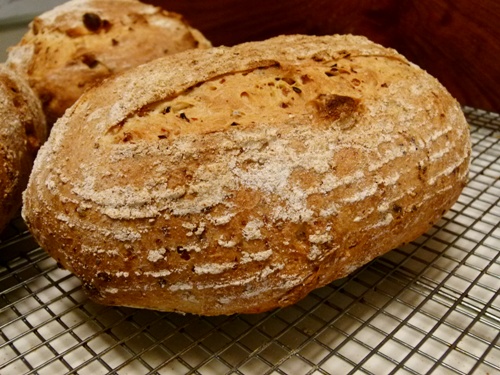
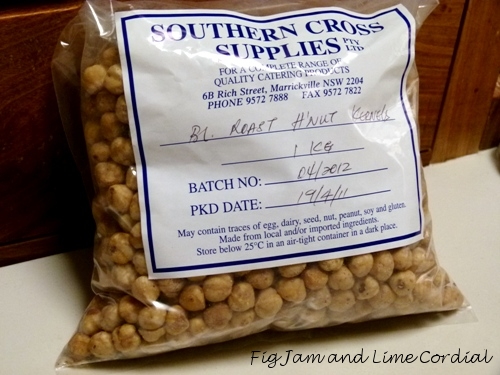
Last week, I wanted to make a grain loaf for a friend, so I pulled Priscilla out of the fridge and gave her a couple of good feeds. A rummage through the kitchen uncovered a half bottle of vintage riesling and the remnants of our bag of roasted blanched hazelnuts

I emptied the last of the grain mix into a bowl and poured over the riesling, intending to soak it for a few hours before adding it to the dough.  Then I remembered an old Dan Lepard recipe that I’d tried a while back, and instead tipped the grains and wine into a small saucepan, and cooked them over a low heat until all the liquid had been absorbed, and the grains were swollen and a little tender to the bite.

Here’s the dough recipe I used (adapted from the basic sourdough tutorial):

  • 300g ripe sourdough starter (fed with equal parts flour to water by volume)
  • 500g water
  • 50g olive oil
  • 1kg bakers/bread flour
  • 135g (dry weight) mixed grains, cooked in riesling, and allowed to cool
  • 165g roasted blanched hazelnuts
  • 20g fine sea salt

I started off with slightly less water – to adjust for the added liquid in the grains – but added the full amount as I felt that the dough was a little dry when I was mixing it.  Once the dough had been squelched together (but not kneaded), it was allowed to rest for nearly an hour before being given a quick fold in its container.

I then left it to prove on the dining room table overnight, and woke to find an enormous, puffy mass (bless you, Priscilla), which needed a well floured bench to be manageable.  I shaped three loaves and gave them a short prove in my bannetons (even though the dough was quite high hydration, I was reasonably confident of being able to turn them out).

After slashing, the loaves were baked in a preheated 220C fan oven for 25 minutes, followed by an additional 20 minutes at 175C with fan for the smaller loaf, and 30 minutes for the larger ones.

The finished loaves were deliciously flavoursome from the wine and roasted hazelnuts, and quite rich. We ate the small round loaf, and passed the other two on to friends.  This was a bread for savouring rather than scoffing.

And as I spread peanut butter over my slice, it occurred to me that this was the true gift of bread making – the ability to experiment and create and play.  I’ve baked a wide assortment of different loaves over the past few years (with varying degrees of success), many of them one-offs, and each loaf has fed my creative soul and provided a greater understanding of the craft.

If you’ve just started baking your own bread, then I’m truly excited for you, because I know what a great adventure you’re on. I wish you as much joy and satisfaction in your journey as I’ve found in mine!

I have been, as we say over here, flat out like a lizard drinking.

Sometimes, when life has been crazy busy, it’s hard to remember that bits of it were actually great fun. Here are snippets of some really enjoyable moments from the last couple of weeks…

. . . . .

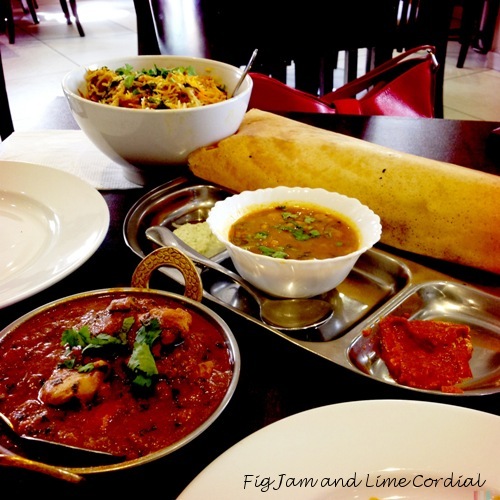
The Spice Girl took me to Harris Park in Sydney’s west for a proper Indian meal. We had a plain paper dosa, chicken methi curry, and a goat biryani. It was all fabulous, including the Bollywood movie playing on the flat screen television, and we congratulated ourselves on being quite restrained and only ordering three main meals between the two of us…

. . . . .

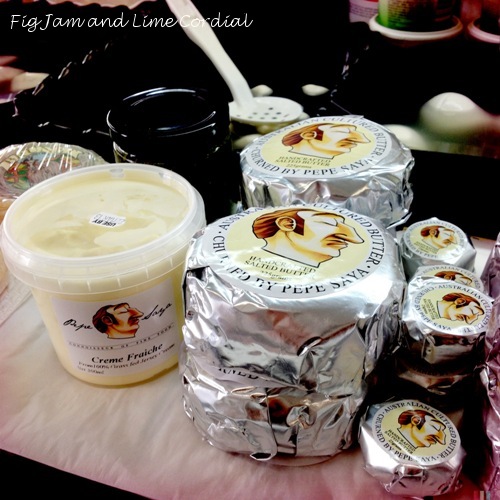
I had a late night text from Johnny at the Cheese Shop to say that they were now stocking Pepe Saya butter.  Of course, we then had to make a trip to stock up – and came home with butter, creme fraiche, some guanciale and a six-pack of amazing San Marzano tomatoes

. . . . .

I’ve been playing with the Hipstamatic iPhone app, and taking photos of my succulents, using the Americana lens and Blanko Freedom film. I love the soft blue tones of this combination.

The echeverias in Nic’s woven basket have grown quite a lot since Christmas…

I’m going to have to re-pot these ones soon…

Some of the graptopetalums and graptoverias in our old laundry tub have died, but the rest have grown up to fill in the gaps…

This variety came from Nic’s garden, and I’m not really sure what it is…

The yellow “Golden Mound” sedums spread like wildfire and threaten to swamp other varieties – but they’re so pretty that I can’t bring myself to pull them out…

. . . . .

Summer is officially over, so I’ve pulled out my kickers, both Luca’s Tony Lamas and my favourite pair of Dan Posts (photo: Hipstamatic app, Tejas Lens, D-Type plate film)…

. . . . .

This little wee thing paid us a visit – he was so cute that I didn’t complain too much about the damage he was about to wreak on our garden…

. . . . .

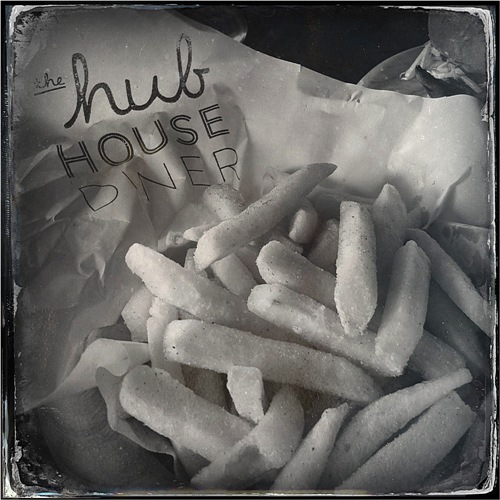
Lunch with my gorgeous friend Tania was the perfect way to end a hectic week.  We ate at the new Hub House Diner in Dulwich Hill. The food was ordinary, the service pleasant and the conversation rip-roaring – Tania is always so much fun to be with and the stress of the week just dissolved into hysterical laughter. Ooh, and I took another black and white photo…

. . . . .

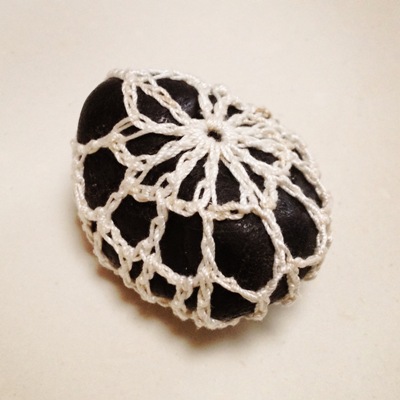
Maude came over and borrowed a rock from our garden, then crocheted a cover for it.  There’s no rhyme or reason behind it, it’s just pure art.  And very Maude…

. . . . .

Friday night pizza with our old friends Kaz and Bob – this one was topped with sopressa, pancetta, basil and our grilled roasted eggplants

. . . . .

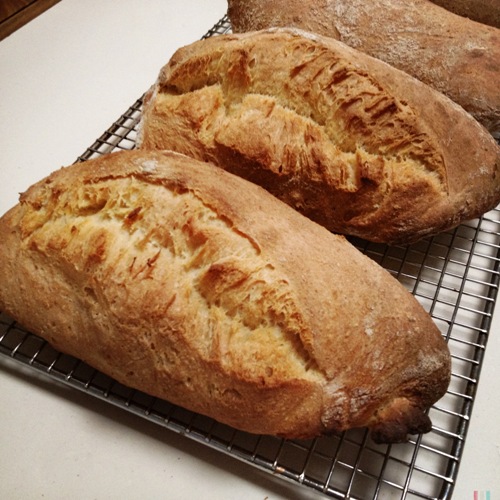
And lastly, a photo of this morning’s ciabatta bake…

. . . . .

How are things in your world?

Are you crazy busy too, or (hopefully) enjoying a period of calm?

As we enter our third year of home vegetable gardening, it finally feels like our garden is really feeding us.

We’re now creating entire meals from our backyard produce, which means we’re eating less meat, with fewer preservatives and lower food miles.  Here are a couple of recent dishes sourced almost entirely from our garden…

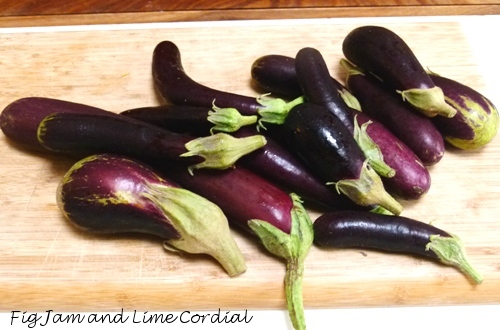
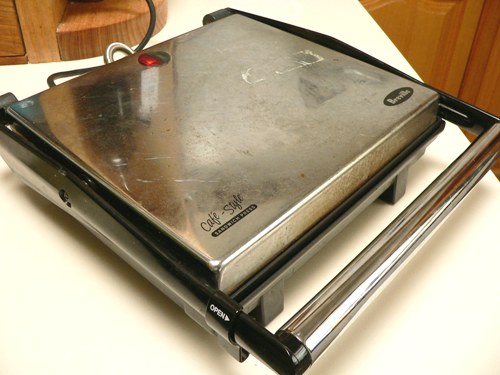
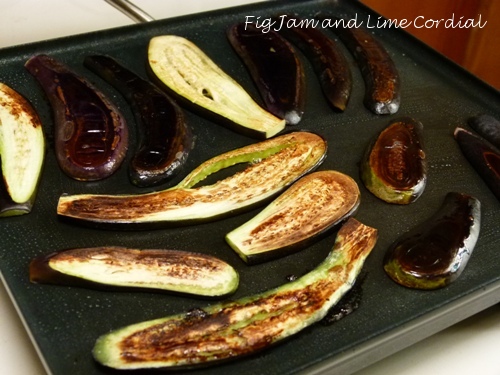
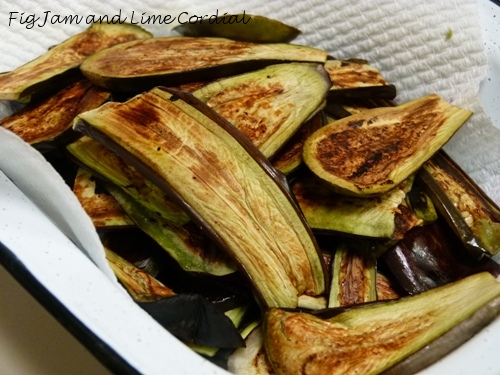
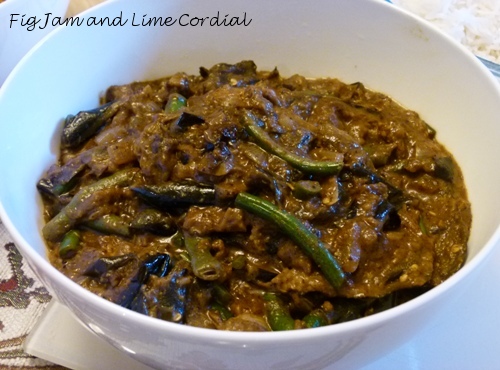
Eggplants seem to do well in our garden, which is a mystery, as their cousins tomato and capsicum always seem to struggle. We recently discovered that it’s incredibly easy to grill them in a sandwich press.  I don’t know why we’ve never thought of it before – it certainly saves energy compared to heating up Bob (the oven), and the whole process took a fraction of the time normally required…

I used two-thirds of the grilled eggplant slices for dinner, and froze the remainder for another day…

The ingredients for our eggplant curry were:

  • chopped onion
  • crushed garlic
  • 2 dessertspoons of Fiji Market curry powder, mixed to a paste with a little water
  • grilled eggplant, cut into bite-sized pieces
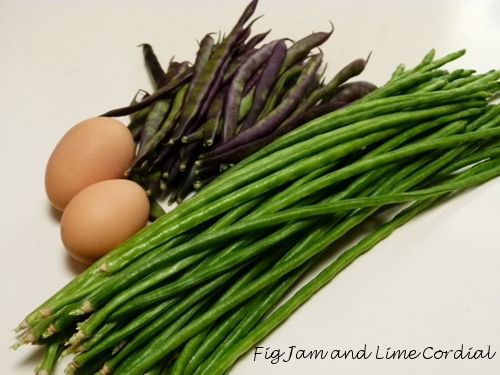
  • beans (snake and purple), cut into 5cm/2″ lengths
  • 1 tin coconut milk
  • lime juice
  • brown sugar
  • dark sweet soy
  • salt

We fried the onion and garlic, then added the curry paste and fried it briefly before adding the chopped eggplant, beans and coconut milk.  The curry was cooked until thick, and then seasoned with lime juice, sugar, soy and salt.

. . . . .

Even though they’re finally slowing up, we’re still harvesting beans daily…

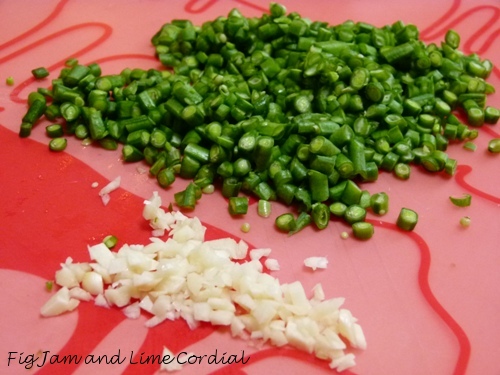
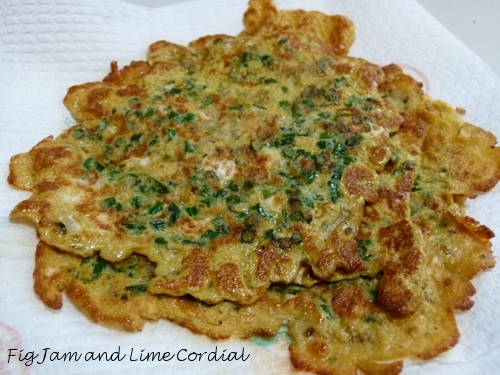
This simple omelette was a staple when I was growing up.  A little garlic and a small handful of snake beans were finely chopped…

Three eggs were beaten with a splash of Teriyaki sauce (my mother uses the ubiquitous Maggi sauce)…

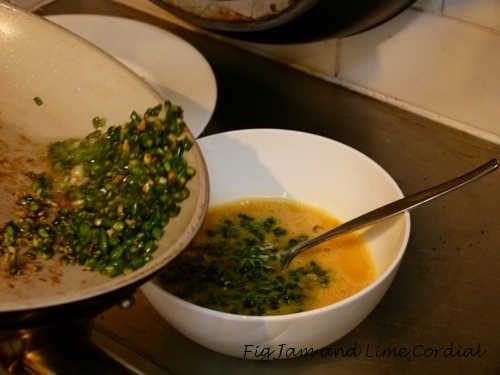
The beans and garlic are fried in a little oil, and then added to the egg mix…

The mixture was ladled into the pan and cooked into flat omelettes. They’re supposed to be round. It’s worth tasting the first one, and adjusting the seasoning as required before cooking the remainder of the batter…

. . . . .

We can’t eat like this all the time, but it’s a great joy that we can do it some of the time. Someone once said to us, “It isn’t possible to be completely self-sufficient in suburbia, so why bother?” Our answer is this: it’s not a case of all or nothing, it’s simply a case of doing whatever we can.  And finding little bubbles of happiness and satisfaction and contentment in the process!