Feeds:
Posts
Comments

spiders-005

There is something immensely rewarding about making things with your hands.  I’ve always been reasonably “crafty” (as in “handicrafts” rather than “sneaky”), but it wasn’t until the boys were born that I discovered how blissfully, soul-fullfillingly happy it makes me to create new things from raw materials.  I’d often say that if I could make something every day, regardless of how small or minor it was, I’d feel that the day had been well spent.  Be it a new brownie recipe, or a vintage crystal spider, or a knitted beanie – often the process of creating is as satisfying as the end product.

I’ve started to wonder – is this part of the secret of contentment?  Do we find our lives so complete and joyous, partly because we can look around and see the work of our own hands?  Maybe that is what life is really about – living in the moment, finding pleasure and satisfaction in your small achievements.

This blog gives me great joy, because it lets me record all the little things we do each day.  Thank you for sharing it with us!

. . . . .

For I have learned, in whatever state I am, to be content.

Philippians 4:11b

pasticcio-005

We hadn’t seen Moo in seven years.  So when he rang a few days ago and asked what we were doing the following night, my instant reply was, “Nothing I can’t cancel”.   We had a wonderful night catching up, discussing everything from sharks’ teeth fossils to remote controlled helicopters.

About ten years ago, Moo (Michael to his work colleagues) sent us a homemade Christmas card shaped as a 3D star.  He’d spent ages cutting out the little points with a Stanley knife.  It hung on our tree for years, until the cardboard finally wore out.  I’ve asked him to send me a new star for the tree this Christmas!

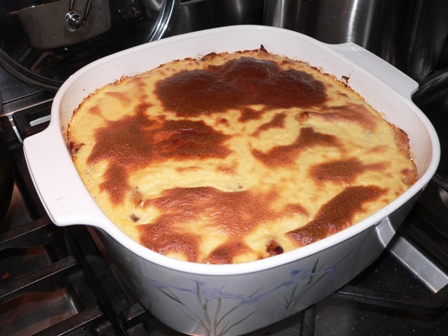
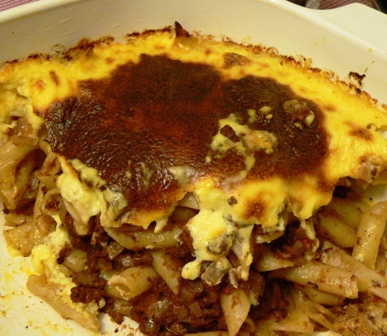
Good conversation is always enhanced by easy comfort food, and Pete’s pasticcio is as easy and comforting as they come.  Well, easy because I didn’t have to make it, but comforting and flavoursome nonetheless.  It’s a traditional Greek dish, characterised by the addition of cinnamon, which fills the kitchen with a delicious aroma as it bakes, and smothered in a golden bechamel , enriched with egg yolks.

  • 2 Tbsp olive oil
  • 2 onions, chopped
  • 500g minced lamb
  • 1 tsp cinnamon
  • 3 tsp dried oregano (if you can find Greek rigani, all the better)
  • 250ml (1 cup) red wine
  • 150g tomato paste (we used homemade, so it wasn’t quite as salty or thick)
  • 500g penne pasta (dried)
  • 125g salted butter
  • ¼ cup plain flour
  • 750ml (3 cups) milk
  • 80g (1 cup) grated pecorino or romano cheese
  • 4 egg yolks

1. Preheat oven to 180C.  Grease a deep baking dish or tray.

2. Heat oil in a large frying pan and cook the onion until soft.  Mix the cinnamon into the meat, then add this to the pan, breaking up the lumps and cooking for 5 minutes until brown and cooked through.  Stir through the oregano, red wine, tomato paste and 2 cups of water.  Reduce the heat and simmer for 45 minutes until the sauce has reduced and thickened.  Season to taste.

3. Cook the pasta in a large pan of boiling water for 10 – 12 minutes until just tender.  Drain and return to the pan.  Stir through the mince sauce, then spoon into the baking dish.

4. Melt the butter in a large saucepan and add flour.  Stirring, cook for one minute, then whisk in the milk until smooth.  Reduce the heat and whisk until the sauce is smooth and thickened.  Remove from the heat and whisk in the cheese and egg yolks (stir fast, so the yolks dissolve in rather than scrambling).

5. Spread the sauce over the pasta and bake for 30 minutes until golden, then rest in the dish for 10 minutes before serving.  Any leftovers reheat brilliantly the next day!

pasticcio-011

white-choc-cake-003

. . . . .

Joyce is my tribe.

A year or so ago, after an enjoyable café lunch, the Yummy Mummies had time to kill and wanted to spend it in a recently opened shabby chic store, full of cut crystal and vintage lace pillowcases.  I was appalled and lobbied very hard for a visit to the butchers instead (“maybe he’ll have beef cheeks this week!”), but my pleas fell on deaf ears.  When I complained to Pete, he said, “Joyce would have gone to the butchers with you.  She’s your tribe.”

Now that you know that, you can probably understand her pain at being without an oven for five months whilst her kitchen is being renovated.  One afternoon last week, the doorbell rang and there was Joyce, looking slightly harassed and asking, “Do you have any baked goods?  We’re desperate!”

Of course, we always have cakes and cookies of one sort or another, so I sent her home with a care package.  When she came to pick up a refill on the weekend, her son Red Roars, whom I adore, sidled up to me and said, “Auntie Celia”…(he only calls me that when he wants something)…”could you please bake me a birthday cake?” How could I  refuse?

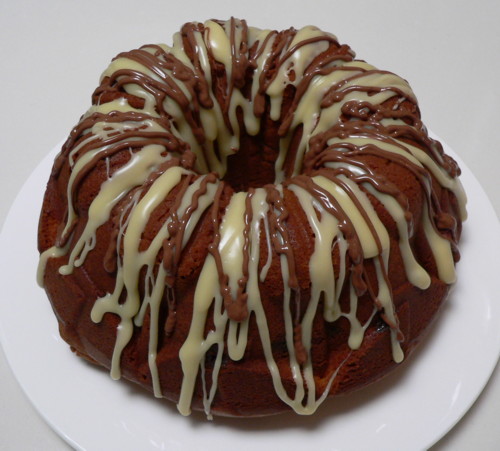
This white chocolate bundt cake is a tried and tested Mrs Fields recipe from her Great American Desserts cookbook.  It is Big Boy’s all time favourite treat.  The white chocolate you use will determine whether your cake is good or great – we use Callebaut, but I’ve successfully used white Lindt in the past.  I’ve substituted Greek yoghurt for the original sour cream with no ill effect – if anything, it’s a little lighter and easier to eat with the reduced fat content.  I finish the cake by either dusting it with icing sugar, or drizzling white and milk chocolate over the top, depending on how energetic I’m feeling.

White Chocolate Bundt Cake

  • 450g (3 cups) plain (AP) flour
  • 1 tsp baking powder
  • ¼ tsp bicarbonate of soda (baking soda)
  • ½ tsp salt
  • 250g (2 sticks/1 cup) unsalted butter, softened
  • 440g (2 cups) white sugar
  • 1½ tsp pure vanilla extract
  • 5 large (59g) eggs, at room temperature
  • 115g (4oz) white chocolate, melted and still warm
  • 250g (1 cup) thick Greek yoghurt
  • 115g (4oz) white chocolate chunks or chips

Topping  (optional)

  • 115g (4oz) white chocolate
  • 65ml (¼ cup) heavy cream
  • 115g (4oz) milk chocolate

1. Preheat oven to160C (320F) with fan.  Spray a 12 cup cast aluminium bundt pan with oil (I never bother dusting with flour, as the non-stick pans are really very good). Note that the original oven temperature was 175C (350F), but I always drop it down a little for the cast aluminium pans.

2. In a bowl, sift together flour, baking powder, baking soda and salt.

3. Cream the butter and sugar in a large bowl using an electric mixer on medium speed until light and fluffy.  Add the vanilla and the eggs, one at a time, beating for 20 seconds after each addition.  Slowly beat in the melted white chocolate.  Scrape down the bowl.

4. Add the flour mixture to the butter in thirds, alternating with the Greek yoghurt.  Beat for 45 seconds after each addition.  You want to end with flour  rather than yoghurt (improves the final texture of the batter). Place the batter in the pan in three layers, separating each layer with the white chocolate chips.

5. Bake for 55 – 60 minutes (I start checking it after 45 minutes) – the top will be brown and a sharp thin knife inserted in the centre will come out with a few crumbs on it.  Allow the cake to cool in its tin for 15 minutes (don’t be impatient), then gently loosen around the edges before inverting onto a wire rack to allow the cake to finish cooling at room temperature.

Topping (optional)

1. Original instructions : In a glass or ceramic bowl, heat the white chocolate with the cream on high until just melted – stir until smooth.  Allow to cool for 10 minutes, then drizzle over the cake.

2. In a separate bowl, heat the milk chocolate in the microwave until just melted – stir until smooth.  Drizzle over the cake.

I’ve never had much success with the white chocolate ganache (it always turns out too runny), so often I’ll just melt white and milk chocolate (separately) in the microwave and drizzle both over the top of the cake (which is what I’ve done in the photo above).  And whilst the chocolate topping does make the cake extra special, it’s really fantastically flavoured and works almost as well with just a dusting of icing sugar.

This is a very flexible recipe, which works well in smaller sizes – cupcakes or fancy mini tins – just adjust the time accordingly to ensure the cakes don’t overbrown.  Most bundt pans I’ve seen are a 10 cup capacity rather than 12, so you’ll have excess batter for baking little extras!

Click here for a printable version of this recipe

040409-022

In hindsight, my first attempt at poppy seed beigli was a little sad.  Not really knowing what I was doing, I used a tinned poppy seed filling which, as June gently scolded, was spread too thin. (Actually, I think the word she used was “stingy”, but in the nicest possible way).

040409-010

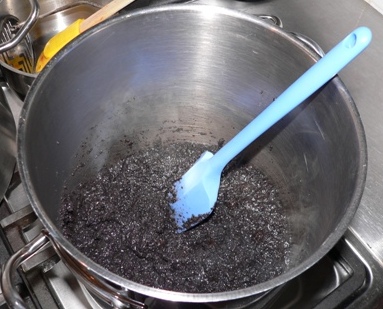
Yesterday, determined to try again, I dug out my beautiful new spice grinder, bought from Herbie’s Spices with my birthday money, and proceeded to grind the poppy seeds required to make the filling from scratch.  I followed the recipe I’d posted earlier, but doubled the amount of filling (I’d hate to be thought of as stingy!).  Poor June – I rang her frantically at 8.15am to ask her what consistency my filling needed to be and she explained that it had to cook until it was “crumbly”.  If you do make this recipe, be aware that you need to watch the filling while it’s on the stove to ensure it doesn’t burn and stick – it’s a very thick paste before you even start.

040409-0111

The other difference was the addition of some homemade apricot jam, which lifted the sweetness a notch and made the rolls just that little bit richer.

I’m pretty happy with these now – as were all the friends whom I delivered rolls to yesterday afternoon!

050409-0511

The wonderful Dot, chef extraordinaire, dropped around a bag of ripe yellow quinces last week.  Pete and I were pretty excited – we’ve bought lots of quince paste in the past, but had never attempted making our own.

After some research, we decided to try our hand at quince jelly – a process which involved washing and chopping up the whole fruit, then boiling it down to mush in water.  Like apple jelly, the whole lot is then drained through calico and allowed to drip through.  We were surprised by how viscous the quince juice was – it didn’t drip much at all – and the calico was probably too thick for this purpose.  We weren’t able to squeeze the fruit pulp, as that creates cloudy jelly, so Pete reboiled the quinces in more water and let them drain a second time to get more liquid out of them.  The quinces produced a wonderful aroma on cooking – a gorgeous, sweet, floral scent which lingered in the kitchen for ages.

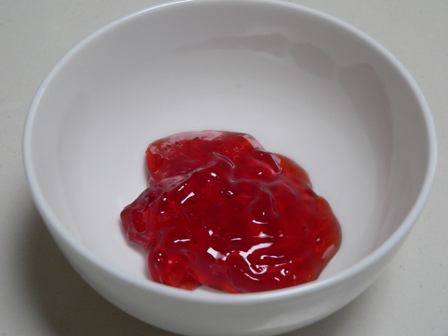
The drained juice was boiled up, lemon juice, sugar and homemade pectin added and this gorgeous red jelly was the end result.

050409-050

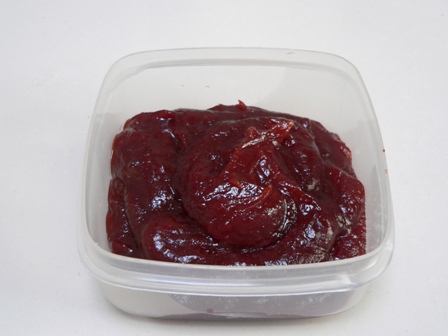
I’d read on the internet that it was possible to reuse all the pulp to make quince paste, so I dutifully dug out the food mill and processed all the leftovers, discarding the seeds and skins.  What I hadn’t read was how gritty the pulp actually is – I ended up having to sieve the puree before putting it all into a large baking tray, with sugar, and allowing it to bake for several hours in the oven until thick.  The quince paste is delicious and worth the effort (just), but I can see why people pay lots of money to buy it!

050409-058

It’s astonishing how much flavour the quinces had to offer.  We were able to use every last bit of them to produce nine jars of jelly and four jars of paste!