This started out as a post about crackling cornbread muffins. But I found I needed to explain why there was crackling in the first place, which then led back to our efforts to squeeze every last bit of goodness out of our pork hocks. I ended up with a very different (and much longer) post altogether. I’ve (obviously) blogged about pulled meats before, but this was a nice opportunity to gather all my meandering thoughts into the one piece of writing. I hope you enjoy it.. x
. . . . .
Recently a friend said, “Celia, not everyone can afford free range”.
I understand that completely. We all have different financial circumstances and priorities, and whilst I think the $30 chickens we buy once a month are great value for money, the critical issue is actually having the $30 to spend on them in the first place. Having said that, if we’re clever and creative with how we handle our meat, the results can be both rewarding and reasonably economical.
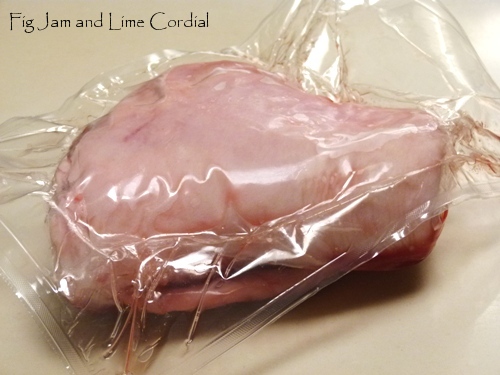
Let me make a suggestion – if you’re an omnivore and funds are tight, consider searching out pork hocks. If you’re really watching your dollars, these can be found at Asian butchers – often with the trotter still attached – for just $3/kilo. Trotter-less higher welfare hocks will set you back about $8-$9/kilo, but with a little ingenuity, a couple of of these (about $15-$20 worth) can be stretched into a week’s worth of family meals. Here’s how we do it…
. . . . .
Step 1
A hock is a gloriously economical cut. If you’re buying a whole lower leg portion, ask the butcher to remove the attached trotter for you, and keep it aside to use in a stew or stock. Use a sharp filleting knife and a scraping motion to carefully separate the fat and rind from the meaty part (but don’t throw the rind away). The hock is basically a calf muscle which needs long slow cooking to tenderise it, but it’s packed with flavour.
To save on electricity, I cook two at a time, in two Römertopfs (I have a big oven). I rub them with a combination of brown sugar, sweet and smoked paprika and salt, then pop them into the presoaked clay pots with an inch or so of water. They go (lid on) into a cold oven, and the heat is set to 140C (not fan forced). All up, they get between four to five hours of slow gentle roasting. The hocks are flipped over half way through the cooking time to keep them moist.
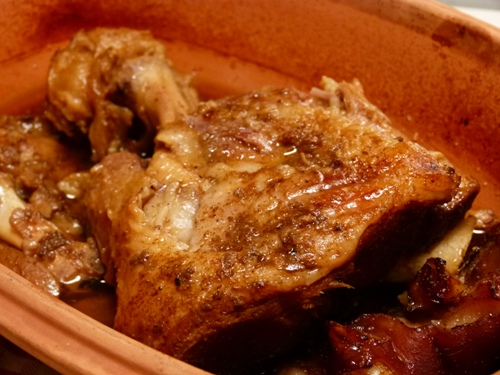
When they’re done, the meat will be tender and falling apart – I shred it by hand and end up with a large tray full of sticky, delicious pulled pork.
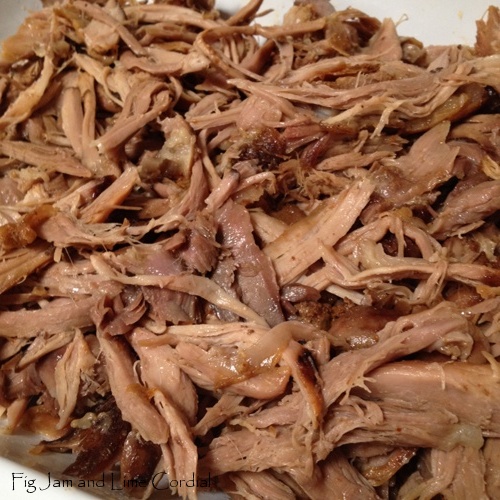
As I’ve mentioned previously, when life is hectic, I’ll do this on the weekend and use the meat as the basis of several dinners over the course of the following week. The meat, stock and fat also freeze well (in separate containers) for future meals.
A couple of thoughts:
Firstly, our original pulled pork recipe using pork neck would work just as well in the dishes mentioned below. And you don’t necessarily need a Römertopf, Nancy cooked hers in a cast iron pot. I’m sure you could also make it in a slow cooker, but I don’t own one.
Secondly, you might be wondering why I always shred my roasted meats. It’s because they go much further that way – if I was to put an entire pork neck or hock on the table, those hungry wolves of mine would make short work of most of it. By shredding first, I can stretch it out to at least three dinners, with leftovers for a few lunches.
Meat is precious, rich fuel and whilst our portions are always generous, we try not to eat huge slabs of it at any one sitting, especially now that the boys are older. When they were younger, lots of meat seemed to be the only way to keep them full!
. . . . .
Step 2
When the meat is done, carefully pour the leftover stock from the clay pots into a bowl and pop it into the fridge to set. Once set, scoop out any fat (there will be surprisingly little if the meat has been trimmed well) and set it aside for a batch of Cuban bread or frijoles refritos.
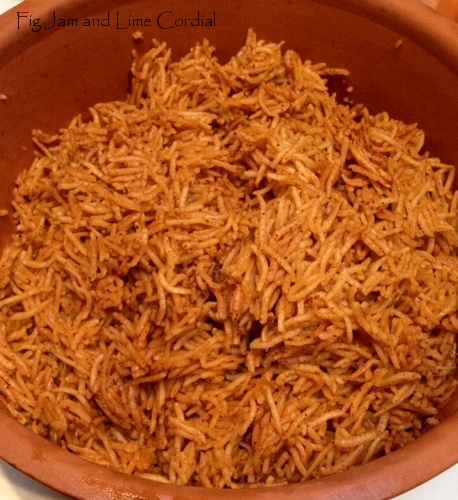
The defatted stock is full of gelatin and will probably have set solid. It is packed with flavour – we heat it very gently to turn it back into a liquid, then cook rice in it (adding extra water if needed). We stir in a little dissolved annatto paste as well for added kick. The stock can also be used for risottos, stir fries or mashed potatoes. I save tiny portions of it in the freezer for adding to pasta sauces.
Here are three dinners which we can pull together easily from our slow roasted hocks (and they’re different enough that I can get away with serving all three in the same week if necessary). We also use the meat in pies, curries and ragù sauces.
There is more than enough meat in two medium-sized hocks for all of the following (providing a generous dinner for four each time)…
. . . . .
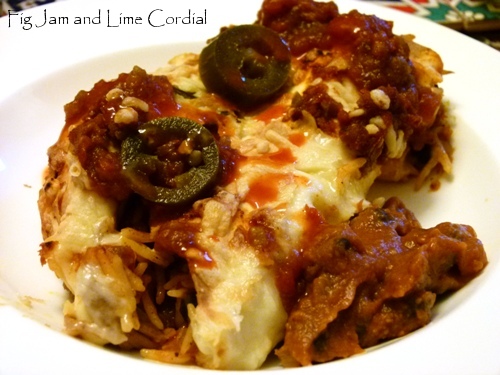
Oven Baked Burritos
pulled pork + rice + tortillas + chipotle salsa + cheese + jalapeños
. . . . .
Cuban Sandwiches
Cuban bread + pulled pork + broccoli raab + cheese + chilli sauce

. . . . .
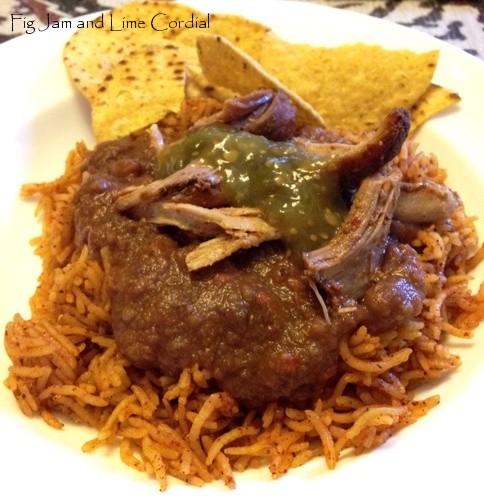
Rice and beans
Rice + pulled pork + frijoles + salsa + salad
. . . . .
Step 3:
Save the rind from the hock and scrape it clean (if you like, you can save the fat and freeze it until there’s enough to render down into lard). Cut it into squares, salt it lightly, then lay it out on racks over an oven tray. Bake in a slow oven for about three hours until hard and crispy (we usually dry bread on another shelf at the same time). The crackling is hard to resist – I have to hide it in the fridge after we’ve had a few pieces each…
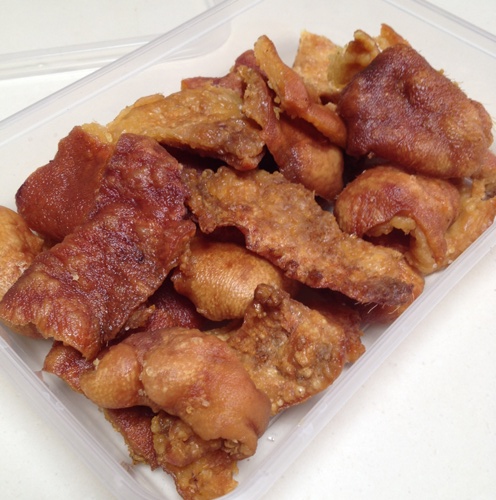
The last time I made crackling, I added the leftovers to cornbread muffins (recipe to follow). Make sure to only use really crispy pieces which won’t go soggy during the baking process…

The leftover muffins were stashed in the freezer for chicken stuffing (as one meal slides into the next).
. . . . .
I believe that eating meat should be a carefully considered, respectful process. We always try to ask ourselves – how can we make the most of this? Can we save the fat, or the stock, or boil the bones up again for more stock? How many dishes can we get out of this?
In this instance, we’ve tried to use every part of our pork hocks and to stretch the cooked meat as far as possible. In doing so, we’ve eaten healthy, satisfying and frugal meals that my family all enjoy.
Searching out higher welfare meat in “cheaper” cuts can be tricky – most places only offer the premium cuts (at premium prices). To find these hocks, I had to make several phone calls – I finally tracked some down at Haverick Meats. I had to specifically ask for them as they weren’t sitting on the racks in their Saturday store, and at $7.90/kg they were twice the price of their non-free range counterparts.
Even so, they were great value for money – for the $20 I spent, we had enough pulled pork, fat and stock for three family dinners, a Saturday lunch, four loaves of Cuban bread and a dozen cornbread muffins. Plus the satisfaction of knowing that we’d squeezed every last skerrick of goodness out of those pork hocks!
Please share your frugal tips with us – how do you stretch your free range meat dollars?
Read Full Post »




























 Fig Jam and Lime Cordial