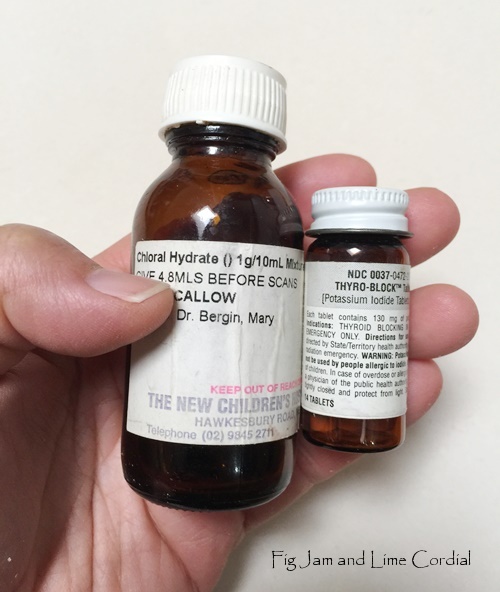
I was tidying up our medicine cabinet recently and found these. And even though they’re nearly 20 years old and very out of date, I couldn’t bring myself to throw them out.
As many of you know, when Small Man was three months old, he was diagnosed with Neuroblastoma 4S cancer. He had a golf ball size primary tumour on his adrenal gland which had metastasized into hundreds of smaller tumours in his liver, causing it to swell to over three times its normal size. Emergency surgery removed the primary, after which the doctors adopted a wait and see approach, as this particularly rare form of cancer was known to “self-resolve”. We were told that the “4S” stood for “Stage 4, Special”.
Thankfully, blessedly, Small Man didn’t need chemotherapy, but he had to undergo a brutal but essential testing protocol over the following four years to ensure the cancer didn’t spread any further. Initially, we spent a fortnight in hospital every six weeks (by the end, we only had to go in once a quarter), and it took its toll on all of us. By the time he was one, Small Man would start crying when we turned onto the motorway entrance towards Westmead Children’s Hospital. In later years, at the end of each round of tests, he would stop talking completely for a week.
The only effective way to track what was happening inside his tiny body was through nuclear imaging scans, so our son was injected with radioactive isotopes and strapped down to a scanning bed. Apparently neuroblastoma kids are notoriously difficult to sedate, and Small Man used to put up an admirable fight. It wasn’t until he was old enough to be hypnotised by the Wiggles that the process finally got easier. Prior to that, the only thing that would settle him even slightly was an elephantine dose of chloryl hydrate – the doctors used to tell us that the dose could knock him out for up to 12 hours, but we were lucky to get 45 minutes. He also needed iodine to protect his thyroid during the scanning process, but he was allergic to the formulation that the hospital used. In the end we had to crush up iodine tablets usually dispensed for nuclear emergencies and feed them to him in a sugar syrup through a syringe.
It was all so long ago but I treasure these old bottles, because I don’t want to forget. They remind me to always be grateful for everything. They remind me how lucky we are to still have our strong, strapping 21 year old son. And they remind me that as individuals, Pete and I are powerful, but as a team, we’re unstoppable.
Sometimes, life can feel very tough. In those moments, it’s good to remember that we’ve been tested before, and we survived. Yep, I think I’ll keep those bottles.






 Fig Jam and Lime Cordial