Feeds:
Posts
Comments

. . . . .

Photos of loaves from the bake-off can be found here.

. . . . .

The cottage loaf is a traditional English bread that has fallen out of favour in recent years.  I absolutely adore making them. Despite a bit of a dodgy start, my last few attempts have turned out quite well, and it’s lovely to have such an unusually shaped loaf to serve at dinner.

I’ve met several fellow bread bakers since starting this blog  (and converted a couple to the cause) – would any of you be interested in joining me in a cottage loaf bake-off?

By “bake-off”, I don’t mean to imply anything competitive.  Rather, I thought it might be fun for us all to bake a cottage loaf or two, and then I’d put pictures up as we go on the Cottage Loaves page.  And since it’s not a contest (and there aren’t any prizes – sorry), I won’t bother with rules – just bake your dough of choice in a cottage loaf shape.   Then leave a comment here with a link to your photo, or let me know and I’ll email you to get a copy if you don’t have a website to upload them to.

Here are my tips – please chime in if you have any others…

  • Use a lower hydration dough.  This is not the time for a wet 75% dough, as the two halves will fuse into each other when you join them, and you’ll end up with some weird looking spaceship.  I use a 60% dough for my sourdough cottage loaves.
  • Let the two storeys have a second rise until almost doubled, before you put them together and give them a third brief rise as a combined unit.
  • Look, I know this bit is cheating, but if you can get it right, the  oven shelf above can stop the loaf from rising too much and “popping” its top off.
  • I aim for the top layer to be half the dough weight of the bottom layer.  I find this works well.  Also, small loaves seem easier to get right than  large ones.
  • Finally, poke a hole all the way through the middle and work the dough outwards with your fingers to try and weld the two layers together.  Slash well – I find lots of cuts helps the dough to rise more evenly.

It takes a bit of practice, but don’t give up, because these are heaps of fun to make.  After all, if Wallace and Gromit can make them, how hard can it be?  (She says, in her best Jeremy Clarkson voice.) And if you’d like a good laugh, have a look at  my failed first attempts.

Edit: If you’re after a bread recipe, you might want to try this Pain de Campagne de Cottage Loaf recipe.  It uses commercial yeast rather than sourdough and works well in this shape.

Please join in – it’ll be great fun!  Let’s bring cottage loaves back into vogue!

Photo from Wallace & Gromit – The Official Site

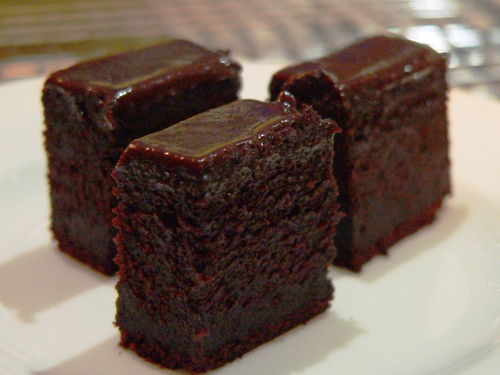
The chocolate slab cake, which I posted about nearly a year ago, has been the most widely made recipe on our blog.

I think that’s because it’s easy to make and results in a large quantity of chocolate cake, without the need for any fancy icing or too much fuss.  It’s perfect for a party, and has the simplicity of a packet mix (almost!), but with really great ingredients – Belgian chocolate, real butter and eggs, and no funny preservative numbers.  Because it’s based around a devil’s food cake recipe, the resultant crumb is moist and tender, and as an added bonus, it slices cleanly into neat portions for sharing.  Here it is cut into baby 3cm squares, so you can see what I mean…

Pete describes it as the chocolate cake equivalent of those little wrapped bars of vanilla ice cream we used to buy when we were kids – unpretentious and comforting to eat in large quantities.

For me, it’s a communal cake, which is why I love baking it so much.  I made a slab yesterday, and a piece has gone to the neighbours, another piece is on its way to the school music department and a third piece will go to my friends at the cheese shop when I make my way over there later on today.

Joanna in Bristol asked me for metric measurements, so I weighed up my ingredients as I was making this yesterday.  Here they are…

Cake

  • 440ml  boiling water
  • 170g dark chocolate, chopped finely (we use Callebaut callets)
  • 110g unsweetened cocoa
  • 300g plain (all purpose) flour
  • 2 teaspoons bicarbonate of soda (baking soda), sifted
  • good pinch salt
  • 285g unsalted butter, softened
  • 380g brown sugar
  • 4 large eggs
  • 2 teaspoons vanilla extract

Icing

  • 100g dark chocolate callets, or finely chopped chocolate
  • 100g unsalted butter
  • 100g icing sugar, sifted (it’s important to sift, or you’ll get lumpy icing)
  • 60ml milk

I’ve also updated the lists on the original post, which has the instructions for putting the cake together.  I hope you’ll try it out.  In our house, having one of these cakes on the go makes everyone feel just that little bit better.

When Big Boy was just a Little Boy (from memory, he was ten at the time), I used to drop him off at the school bus.

Every morning, in the car, I’d drill him.

“What are the two things you need to remember today?”

He would roll his eyes, sigh, and reply.

“Life doesn’t owe me a living…”

“Yes…and?”

“Sh*t happens, and I just have to deal with it.”

I always figured that if he had those two thoughts well and truly entrenched, then he could deal with whatever the world was going to throw at him that day.

Life doesn’t owe us a living – as Mark Twain once said, it was here first.  I want my children to really take that to heart, and to be grateful for all the good things that come their way. More importantly, I want them to understand that, blessed as our lives are, it isn’t because we’re in some way deserving, we’re not entitled to anything, nor are we allowed to whinge when things don’t all go as we planned.

Secondly, stuff is going to happen. Life occasionally throws curve balls.  When the unpredictable, the unpleasant and the downright difficult happen, then we just have to pick ourselves up, dust off, and get on with it. I can’t prepare my children for specific problems they might encounter, but I can try to teach them that unexpected hiccups are a part of life. Hopefully, if they know it’s coming, then they’re better placed to bounce back from whatever the difficulty might be.

Parenting is such a tricky, constantly evolving process. I’ve been blessed with amazing role models in my own parents, but life has changed so much in the last thirty years that Pete and I often have to figure it out as we go along. Thankfully, we have boys with gentle, kind dispositions which just makes everything so much easier.

Do you have a funny story to share about your kids?

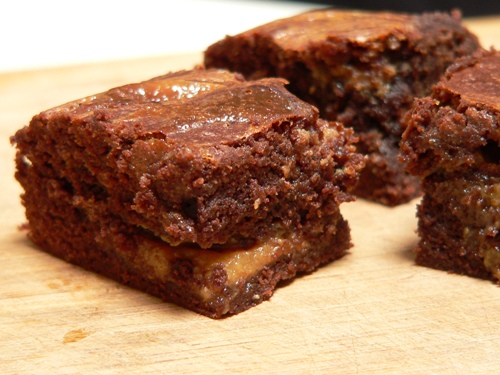
These brownies, based on a recipe by David Lebovitz, were the perfect vehicle for the dulce de leche we made a few weeks ago.  They’re made in a saucepan rather than a mixing bowl, and were much better the second day – it’s definitely worth making these the day before you need them.

  • 125g unsalted butter
  • 170g dark chocolate, finely chopped, we used Callebaut 54% callets
  • 25g Dutch-process cocoa, we used Callebaut
  • 3 large (59g) eggs
  • 200g white sugar
  • 1 teaspoon homemade vanilla extract
  • 140g flour
  • ¾ cup dulce de leche (DL uses 1 cup, but I didn’t want to open another jar!)

1. Preheat oven to 175C with fan.

2. Line a 20cm square brownie pan with a sheet of parchment, folding the corners so that the paper fits in neatly and comes up the sides of the pan.

3. In a medium sized saucepan, melt the butter.  Add the chocolate and stir over very low heat until melted.  Remove from heat and whisk in the cocoa powder until smooth.  Add the eggs one at a time and mix well with a wooden spoon or spatula, then stir in the sugar, vanilla and finally, the flour.

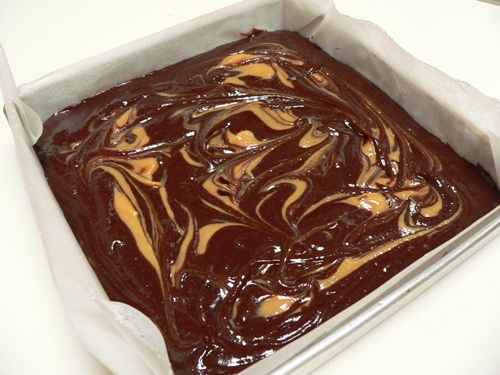
3. Scoop half the batter into the prepared pan.  Drop spoonfuls of the dulce de leche over the surface of the batter, then drag a knife through to swirl it in slightly.  Use about a third of the dulce de leche, reserving the rest for the top.

4.  Spread the remaining brownie batter over the top, then repeat the dollop and swirl process with the rest of the dulce de leche.

5. Bake for about 35 minutes, or until the brownies are browned and the centre no longer feels too squidgy.  David describes it as “just-slightly firm”.

6.  Allow the brownies to cool completely before cutting.  Because we used homemade dulce de leche (which was quite soft), the caramel sections of our brownies were oozy and luscious.  They really are better on day two, although it was hard to keep the boys away from them for that long!

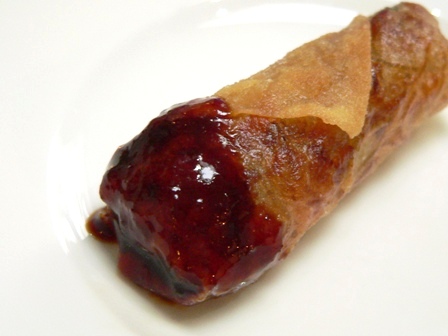
Last night we made spring rolls, filled with pork mince, shredded vegetables and vermicelli noodles.  The mixture was stir fried with a little light soy, before being rolled in spring roll wrappers and deep fried…

Thinned with a little water, Pete’s plum sauce made the perfect accompaniment to these!

. . . . .

We marinated belly pork in plum sauce, soy, sherry, a little cornflour and sesame oil, then braised it in pan.  Not quite the right cut of pork for this dish, but delicious nonetheless!